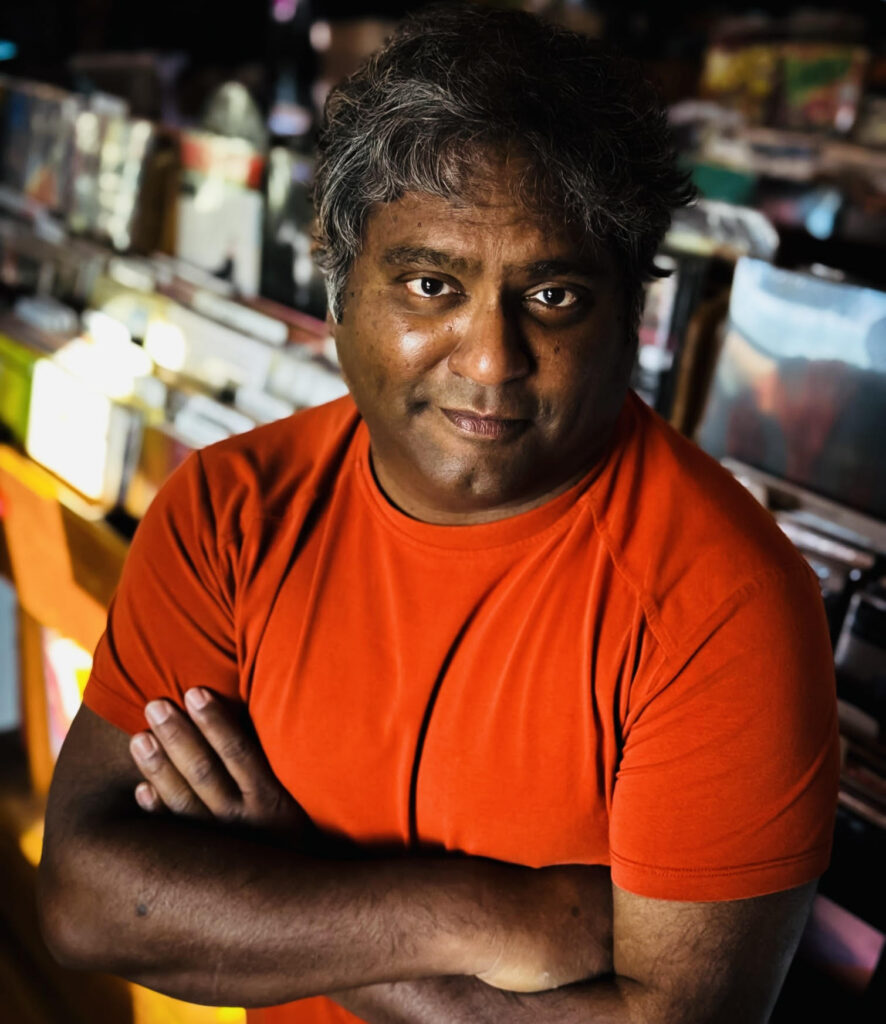

Photo credit: Nita Ann; Courtesy of Charles Alexander
Musicians across the world have taken recent revelations from The Atlantic’s AI watchdog project personally. Embedded in the investigation published by the magazine was a search tool that enabled music-makers to see which of their songs are included in four massive digital data sets. Several of those, including the Free Music Archive, were created for noncommercial use, but they could very well have also been used by Suno, Udio or other AI music companies to train the models on which they’re building business.
It’s no wonder that independent artists working in every conceivable style of music — as well as superstars of SZA’s stature — were in their feelings at the prospect of AI companies exploiting their creativity. Their work has been increasingly devalued since digital downloads and streaming supplanted physical product.
I soon saw Charles Alexander, a Nashville-based songwriter and digital strategist wade into the online discourse. (He lectures on AI in MTSU’s recording industry program and co-founded a company that helps protect artistic work through digital fingerprinting.) And since his explainer video suggested that interpreting the results generated by the search tool was more complicated than it initially seemed, I asked him to talk through it with me.
Jewly: In the days after The Atlantic investigation was published, I witnessed this crescendo of artist responses lamenting how the unlicensed use of their music to train AI models undermines their careers. What about the discourse got your attention?
Charles Alexander: In my feed … there was just so much conflation and misinformation about what was going on. And I understand it. I get it.
You could sense this palpable sense of anger from the creative community. But I also think it’s because everybody in the business, from people who create music to people who work in the music industry, especially the independent level, have cumulative and collective trauma around all of this stuff, based on the history of what’s happened, even just in the last 10, 15 years.
[I want] to be careful and sort of sensitive to all of that stuff, but also, I’m trained as a scientist, so wanting to get the objective truth out there.
There’s been real concern about AI among musicians for several years now, but not much clarity about exactly what music AI music companies are using to train their models. Has this recent discourse has made you think about why musicians found the prospect of a tangible search tool so compelling?
There’s no transparency around any of this stuff. To the best of my recollection, unless you work in this space, this was one of the first events where there really was a public facing interface to what could possibly be used to train these models.
I think The Atlantic did a great job of creating this user interface. You just plug in your name and then everything kind of pops up. I think it’s natural, if you are a creator and a writer and an artist and a musician, to go, “Oh my God, it’s in this database, therefore it’s been used.”
In the video you made, you emphasized the distinction between what songs are included in these data sets and what music is actually being used by which AI companies. Could you boil down that difference?
None of these companies have contested the fact that they’ve used publicly available data to train their models. But they haven’t specified which publicly accessible data.
And beyond these four data sets [mentioned in the article], there are other data sets out there that are also available publicly and that are easily accessible if you know where to go looking.
Just because your music was found in this data sets, it didn’t necessarily mean that those songs and those data sets were used to train AI models at the generative AI audio companies.
Where I think the distinction is, is that if your music was used to train a commercial AI product, you have grounds to go after those people from a copyright standpoint. But at the same time, you also need to be able to prove that that event occurred. And the proving part is where I think all this kind of like craters. Because attribution is difficult. It’s really difficult to prove unless you have unlimited resources and you have a machine behind you that can get in there and audit things.
What do you think is the takeaway from that Atlantic piece and all of the discussion around it?
The largest story here for me is that if your music or your intellectual property or any kind of content is online on a digital surface, it is open to being exploited. So you wanna be really careful about just clicking away and agreeing to every terms of service. You should read terms of services, even if they are 12 pages long, and then decide whether you’re gonna give permission.
Nashville tech startup provides new licensing and tracking tools for the AI era
You’ve been working in this space with ViNiL for a little while now, so what kinds of concerns and desires for more control our clients bringing to you
You can’t run around going whack-a-mole and saying, “Take this down, take this down,” because the tech is so good. And the rate at which the stuff goes up is so fast that the moment one comes down, like, 10 or 20 more take its place.
So the way we think about this is that if someone sees a piece of content that has you in it, we want the general public or your business partners or whomever your sort of affiliates are to look at it and go, “Okay, that wasn’t authorized.” And then also give people a mechanism to ask the platform or compel the platform to take down stuff that you didn’t authorize.
Most of our clients, they basically want something preemptive to even prevent stuff from going up.
Just a couple of days after that Atlantic piece came out, I saw the news that a law firm that’s known for winning class action suits joined an existing lawsuit brought by Delgado Entertainment Law against Suno and Udio on behalf of independent musicians. What did you make of that timing? Was there any correlation there, do you think?
I think the news around the AI Watchdog project probably made them announce that quicker than they maybe were planning on.
But I also welcome any effort that’s gonna try and have accountability for some of these platforms. Because I think [those law firms] are right that there has been no initiative to protect independent musicians from having their IP end up in training data for some of these generative AI companies. I hope they’re successful.
Earlier you referred to the baggage people in music are already carrying when it comes to technology. They’ve already seen the major labels cut deals with Spotify that didn’t result in more fair compensation for music-makers. How would you compare the three majors suing Suno and Udio, and resulting settlements, with the class action lawsuit against those companies on musicians’ behalf?
I don’t think this is news to anyone, but we have a long history of having competing interests fighting for the same thing. I’m not sure how to solve that particular problem.
We’re now at the point where as a culture and as a society, especially here in the United States, we’re devaluing and commoditizing art, and then we want people to act differently after they’ve seen that pattern over a few years.
I think creatives need more agency. For us, the biggest thing is consent, control, and compensation. So if you don’t want your stuff on any platform, you should have the ability to withdraw your intellectual property at any time. You should have ability to control that intellectual property. And you need to be compensated for your IP.
Lawmakers seem to have moved slower on AI than the pace of a lot of these other developments. Tennessee did pass the Elvis Act in 2024. And the national version, the No Fakes Act, was introduced the same year, and now seems to finally be moving forward. You ended your video with a call to action, urging people to voice their support for the No Fakes Act to their representatives. What difference do you think it would make if that law was in place nationally?
A thing to clarify about the No Fakes Act: that has more to do with your name, image, and likeness. The idea being if someone used AI to clone you and then create digital deception around this stuff, then the No Fakes Act has some teeth around it where you can go after these bad actors
Here’s the thing: I think we need a bundle of legislation. We’ve already done the first one, which is the Take It Down Act, which has non-consensual images. That moved fairly fast and is now law. It gives any distribution service or a platform or corporation 72 hours to take down any kind of infringing content.
No Fakes is the second step in that. We need the legislation to protect possible victims, or really to go after the bad actors. Hopefully, it gets through the House, and it becomes law, and then that sort of builds a runway for this third thing called the TRAIN Act. That will actually institute a legislative tool to go after training data that’s been used to train [AI] models.
If you’ve seen your IP surface in some of these data sets, I think it is important to make it known publicly that you’re upset about this and that you are going to take some action. I think you need to engage in the legislative process and empower your representatives to do the thing you want them to do.
It’s going to take legislative [action]. It’s gonna take public legal work. It’s gonna to take public pressure, because in the world I live in, public pressure probably counts for a lot.
Mere months ago I had a conversation with a colleague who told me they didn’t think that we’d reached the point where the general public was invested in matters of AI and music. What’s your view?
I think up to this point, and I don’t mean to oversimplify, AI and the deep fake AI tools or the generative AI tools has been fun and games. It’s pretty amazing for the average person in the street to be able to log into a platform and then say they wanna write a song about their dog catching a frisbee. To be to able to do that, and then it’s sounding pretty good, is pretty impressive.
We are at an inflection point. Like everything else that works or doesn’t work or that’s in the public sphere, it doesn’t matter until it affects you personally. And at some point, some of these things are going to affect people in their personal sphere.
I think the average person probably, at this point, can’t tell or doesn’t really care, but I think we’re about six months to a year away from them caring. Because it’s gonna affect Christmas. It’s gonna effect the election process. It’s going to effect other kinds of things that people do day-to-day, like shopping. We’re gonna have to be preemptive and thoughtful about how to address these things
Copyright © 2026 WPLN News