The music industry evolves at a dizzying pace. Senior Music Writer Jewly Hight is here to help you make sense of the “Key Changes” in these twice monthly roundups of music new analysis.
“The audacity of this claim.” Not long ago I received that text from a fellow writer, accompanied by a screenshot of a performer proclaiming themselves the “first” to accomplish a particular milestone. People can be quick to make that type of grand statement, despite the dangers. For one, they can be proven wrong by anyone who does a bit of research. And on top of that, they’re essentially erasing all predecessors.
But claims of pioneering status often aren’t fact-checked because we tend to have such short memories. Buzzy newcomers and micro trends can seem like they emerge out of nowhere. They have their moment, then fall off the radar and are quickly forgotten. And that can be a draining cycle to follow, not to mention one that leaves little room for looking back.
So today, I’ll help you take in the bigger picture — because no music emerges or evolves in a vacuum.
Lately, I’ve looked into how and why artists are giving credit where they feel it’s due, and connecting their work to musical and cultural lineages that were around before them.
Take Veronique Medrano, a Mexican-American singer and songwriter from Texas.
Veronique Medrano
In the 2010s, she began developing a repertoire that combined Tejano and other Mexican regional music styles with country and Americana. One of the many classics she’d play live was the sorrowful 1975 Freddy Fender smash “Wasted Days and Wasted Nights” number, only she’d worked up her own insistent and syncopated cumbia-style version.
It became a real crowd-pleaser. And Medrano told me that she’s “very much of the mind that I wanna know the history of a song that I am recording, and the artist behind it, if it is not my own, so that I know what I’m talking about.” And the more she learned about Fender’s career — the enduring hits he earned across decades and the mark he made as a Mexican-American star — the more importance she placed on educating people about Fender and many other Latin country performers who came before her.
How else, she reasoned, would people understand where she fit?
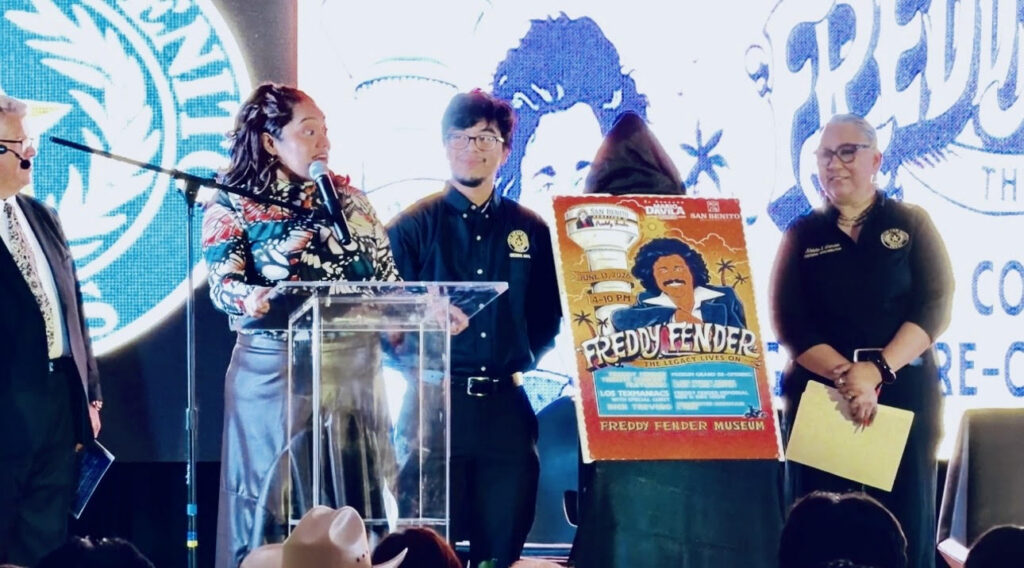
Medrano even got her masters from the University of North Texas and became a trained historian, advocating for his induction in the Country Music Hall of Fame (he hasn’t been inducted) and assembling exhibits on Fender. Roughly a year ago, she was even brought on as the official archivist of his estate. Her commitment was to “preserv[ing] history the right way, so that somebody can be seen to their fullest and understood as not just kitschy and pandering, as though they’re just singing in Spanish for this and that. Freddy may not have been exactly the first, but he definitely wasn’t the last.
“You have to understand how impactful he was,” she goes on, “to better understand why Latinos and Mexicanos will always be an integral part of country music. The thing is, there was a face to it.”
Numerous faces, actually. Another Tejano legend Medrano’s archival work has spotlighted is Selena.
Kacey Musgraves
Kacey Musgraves, who isn’t hispanic but proudly claims Texas, has begun paying tribute to Selena too, to the delight of audiences at the Houston Rodeo and her arena show in Mexico City.
At this point, Musgraves has built a global audience for her coolheaded singer-songwriter style of country music. And as she told me in March, she’s begun using her platform to convey her appreciation of Mexican roots of the genre, of ranching and rodeo and of Texas culture itself. That’s a notable departure from the prevailing pattern of white country artists engaging in borrowing, in order to season their work with Latin flourishes, but stopping short of acknowledging the influence and importance of those musical traditions.
Meanwhile, Musgraves is held up as an influence by a new generation of country stars.
Megan Moroney is one of the biggest, and she credits Musgraves’ first album – which definitely wasn’t viewed as radio-friendly – with inspiring her to write her own chart-toppers. Moroney made clear how much she values Musgraves’ template by asking the elder artist to guest on a smartass new duet.
Gillian Welch
Three decades into her revered songwriting career, Gillian Welch is emphasizing one of her longtime influences, the Grateful Dead. For years, the elders she was most closely associated with were icons of Appalachian austerity, like Ralph Stanley. But here and there, she and her music-making partner David Rawlings would reinterpret tunes made famous by the Dead. This year, they worked up an entire show’s worth.
Welch told me in a recent interview that looking back on the Dead’s place in ‘60s counterculture was like holding a mirror up to her own quiet quest to buck convention and find flexibility in tradition.
And that insight can certainly enrich how we hear her work too.
Copyright © 2026 WPLN News