In the age of generative AI, the music business is becoming something much closer to a tech business. Last week, a new Nashville tech startup called ViNIL rolled out a digital licensing and tracking service that wouldn’t have been needed just a few years ago.
The company is offering a way for artists to control — and get compensated for — how their voices are used, whether in recorded or AI-generated form. The platform will also allow companies to verify that the sound it’s licensing is legit.
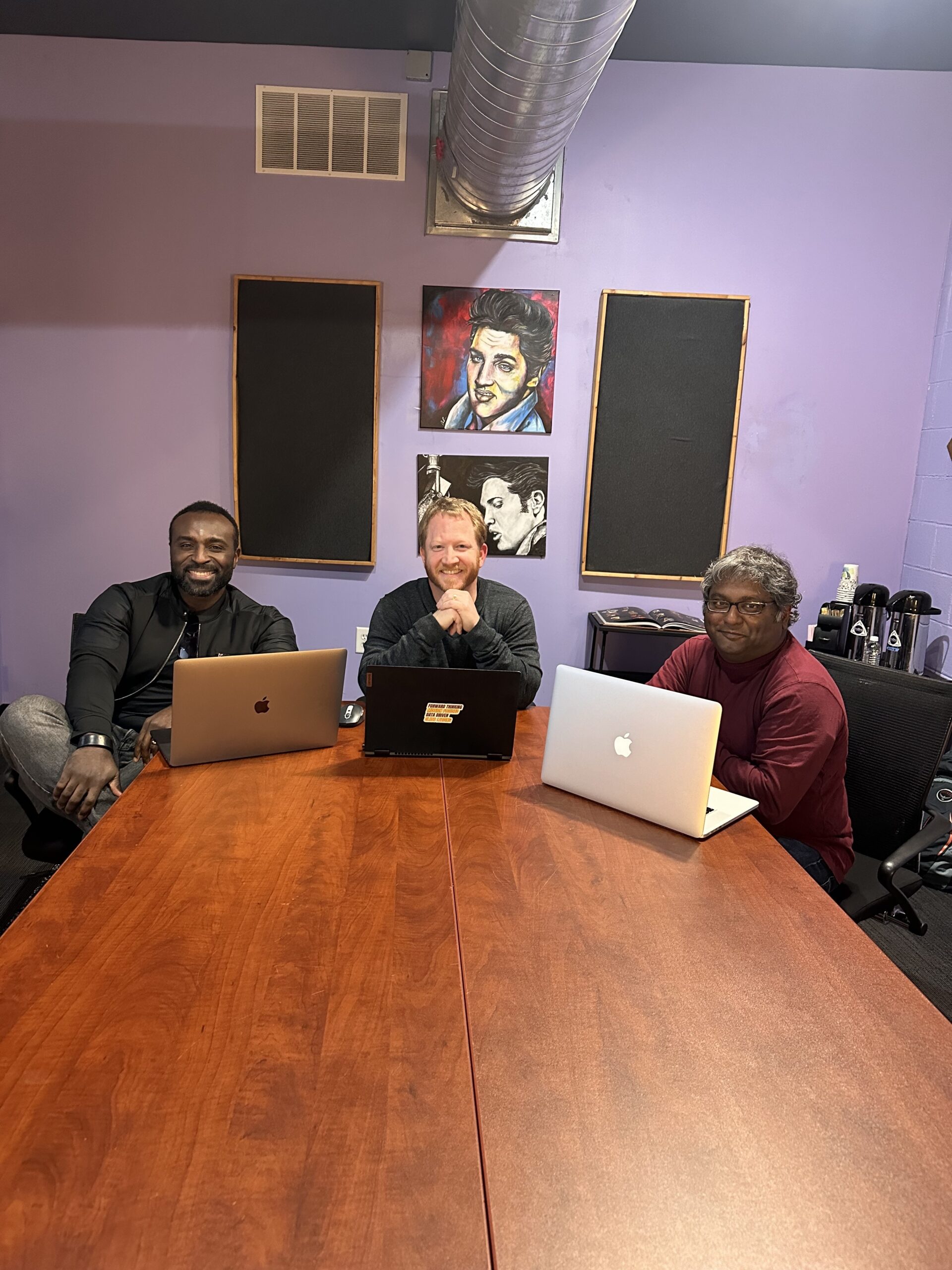
ViNIL’s three founders have been operating out of a small conference room in a co-working space on the edge of downtown Nashville. They introduced their platform to the music industry and allowed their first users to sign up at the SXSW conference in Austin last week, after 10 sleep-deprived months of planning, building and testing.
“Before we did any of that stuff, we beat this into the ground,” noted CEO Charles Alexander, adding that following each brainstorming session, they photographed everything they’d scribbled down.
His co-founder Jeremy Brook chimed in, lightheartedly, to help set the scene. “And importantly, there are pictures of Elvis all over the walls. It’s our muse.”
He cut his eyes toward the paintings hanging behind him. Elvis’s facial features appear slightly off, more like close approximations than the real thing.
“And, you know, a certain irony,” Brook went on, “given the title of the Tennessee law designed to address the very problem that we’re seeking to address.”
Brook is talking about the ELVIS Act — a piece of legislation that’s rapidly made its way through the Tennessee General Assembly this year. The bill would make it illegal to manipulate someone’s voice through AI without their consent in this state.
What set all this activity in motion was a now-infamous example of familiar voices being faked, said Sada Garba, the third mind behind the new company.
“We discovered a song that was a collaboration between Drake and The Weeknd that was so bumpin’. And we were like, ‘Check this new [track] out.’ And it turned out neither Drake nor The Weeknd had anything to do with the song. But it was so convincing.”
That’s what was so troubling, the founders emphasized.
“There is a problem that has never existed in the world before,” says Brook, “which is that we can no longer be sure that the face we’re seeing and the voice we’re hearing is actually authorized by the person it belongs to. It’s a form of digital counterfeiting and, frankly, identity theft that is brand new. So that’s really the thing that we’re focused on.”
Brook is an entertainment lawyer, specializing in intellectual property, Alexander is a digital strategist and singer-songwriter and Garba, previously a game developer, writes computer code. Together, they decided to meet a new technological issue with a tech solution.
“The primary conversation around this stuff was, ‘Oh, they did something illegal,’” Alexander explained. “Problem is, there was no legal way to do it. So there’s no licensing platform for any of these assets. Someone should do this.”
“The primary conversation around this stuff was, ‘Oh, they did something illegal,’” Alexander explains. “Problem is, there was no legal way to do it. So there’s no licensing platform for any of these assets. Someone should do this.“
They obsessively searched the internet to see if anyone else had beaten them to the idea, and since they couldn’t find anything, they concluded it was their void to fill.
Alexander and Garba gave a demonstration of the platform on their laptops, across the table from each other.
“I’m currently logging into the licensor profile,” said Alexander, typing away on his keyboard, “and Sada is logging into the licensee profile. And so now what’s going to happen is Sada is going to request a license from me.”
Garba pointed to his own screen: “I log in to my brand account and I pull up the license request form. I fill in the details for the request. I could be any company out there, Apple, Coca-Cola, anyone who wants to employ the use of Charles the artist, his voice, towards some commercial I find Charles and then send him a request through the portal. And then he should receive it in real time.”
“There it is,” Alexander confirmed. He wrote back, asking for a higher fee.
Garba deadpanned, “I see that Charles wants more money. How typical.”
“So I would say, ‘Okay. Double the campaign amount.’ And then I can attach any supporting documents that I want to this, just like any classic chat system, and send it back to Charles.”
Alexander decided the theoretical fee is sufficient. “Then I can act on the action and say ‘accept’ and ‘generate license.”’
And what would Garba get?
“We’re going to send assets back and forth,” Alexander explained, “like audio files of my voice. And then if there’s a need for him to train my voice in a voice model, he can do that on a different platform and then send me that stuff. Once all that is done, we can feed that into this thing called the Media Asset Library. Then we will be able to fingerprint that and generate a file that we can cryptographically stamp, and then we can track it.”
“This is really the heart of the platform,” Garba pointed out, “this certification and tracking.”
A digital stamp that looks like a QR code would follow that file forever after.
But if you’re wondering why such an innovative company is named for a physical format that the music industry has used, in one variety or another, for over a century, well, it’s not the same old spelling of “vinyl.”
It’s an acronym chosen with the still emerging power and potential of AI in mind, one that stands for:“Voice. Identity. Name. Image. Likeness.”