Has there been a more ubiquitous logo than the American flag?
The stars and stripes have adorned endless products: hats, coozies, swimsuits, stationery, paper plates, beer cans, running shorts, socks, jackets, sweatshirts, scrunchies, jewelry, face masks, lapel pins and plenty else. That red, white and blue symbolism has also served as fodder for all manner of artistic expression.
Every generation of country music since the 1950s, when the country music industry and the U.S. military forged a mutually beneficial alliance amid the Cold War, has taken up patriotic themes and referenced the flag, often in ways that transcended political affiliations. (For more on that history, read scholar Joseph Thompson’s book Cold War Country.)
But with the spread of President Trump’s “Make America Great Again” movement in recent years, some feel the stars and stripes have become more a symbol of political division than national unity. Recent songs from country stars Morgan Wallen, Brantley Gilbert and Lee Brice portray their side as the only one that can claim the American flag.
That’s not the only outlook in the broader country music landscape. At the edges of the mainstream, some artists have found ways of freeing the flag from that narrow meaning.
Pynk Beard, an independent country artist from Alabama, is particularly disinterested in drawing battle lines. His song “Ice On the Road” is an appeal to meet differences between people with compassion.
The chorus arrives as a series of questions. Pynk Beard wants to know how the targeting of immigrants squares with people’s beliefs, no matter who they voted for. “Where are your neighbors?” he sings, his vocal attack conveying muscular warmth. “And when’d you last see ’em? Is anything great yet? Have you met Jesus? And what was he teaching? Did you believe him?”
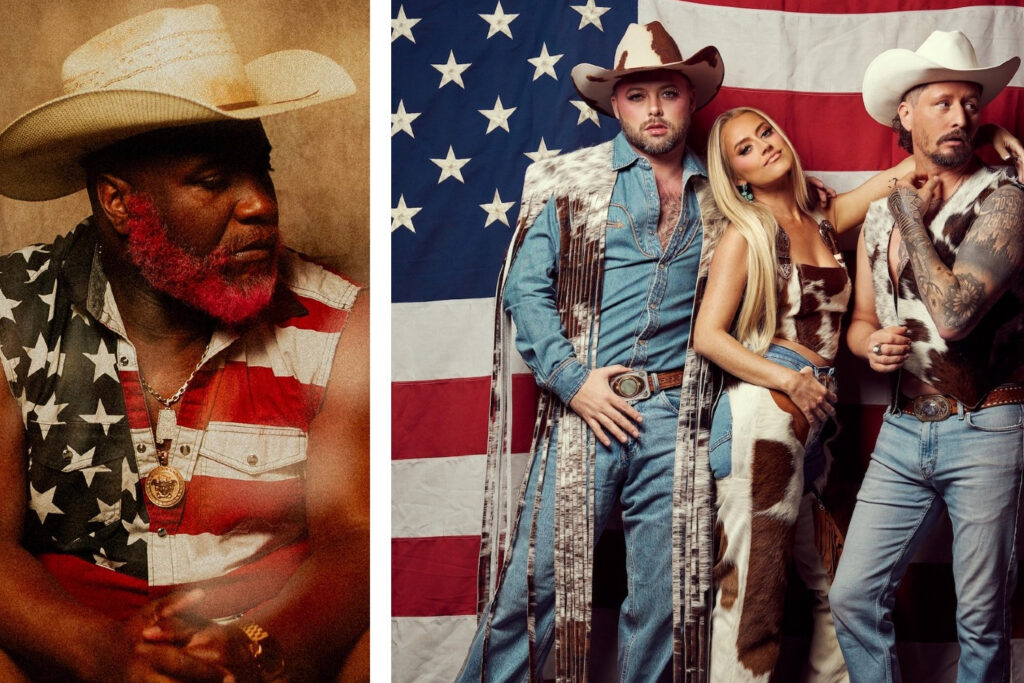
Pynk Beard paired the song with a pensive photo of himself in a straw cowboy hat and sleeveless western shirt printed with the American flag. This is a guy who dyes his beard fuchsia — nothing about his look is accidental. He’s certainly contemplated how others will see him.
“He’s a six-foot-tall Black man, pink beard, brown eyes,” he lists off thoughtfully. “And that’s just a list of attributes. But I felt like wearing the [flag shirt] put a real weight, like, ‘I am an African American.’ This is my lived experience, in other words. And so visually I wanted people to know, ‘Okay, this isn’t just some guy who’s riding some country wave, you know, trying to pick on country artists.’”
Because Pynk Beard’s one of them. In the past, he’s written Grammy-winning songs for big-name pop stars, but he’s fully embracing his lifelong country leanings in his own music. And he takes pride in mentioning that he’s the son of an Army veteran.
“To a degree, the iconography of the American flag has kind of been sequestered to one side,” he reflects. “‘This is ours, and when we do it, the flag represents this.’ And I’m like, ‘No, that flag represents everybody here. And I have just as much right to it as anybody.”
“America is not made up of a flag,” he goes on. “It’s made up of the people behind it. The flag doesn’t lean right or left. The flag is not liberal or conservative.”
That doesn’t mean it’s an easy emblem to interpret right now. Just ask the Cowgays, a new queer country trio with a mischievous streak.
The group’s first social media posts showed them singing their tongue-in-cheek, gospel-style debut single in front of the American flag. And they knew exactly what they were doing: reclaiming a symbol and a sound.
“I think a lot of people feel like country music isn’t theirs,” muses Cowgays member Adam Mac. “Like, it doesn’t belong to them because they don’t believe the same things that they assume all country music singers believe. We wanna push for a better America. So why can’t that flag stand for our values?”
A few commenters were confused by seeing them testify to shedding homophobia in front of Old Glory. And for reason, says Chris Housman, who’s also in the trio: “The flag stays the same, but what the flag means changes constantly.”
Bandmate Brooke Eden experienced the evolution firsthand. As a solo artist, she released a song called “American Dreamin’” a dozen years ago. President Obama was in office and Eden wasn’t yet out. Back then, she felt accepted as an all-American girl. Now? Not so much.
“You’re only allowed to be American if you’re white and blonde and straight,” she says.
The Cowgays found Eden’s leftover “American Dreamin’” merch t-shirts, adorned with American flags, and Mac reports that they’ve given them a playful update: “We’ve cropped them all and made them into the gayest little Fourth-of-July crop tops.”
They’ve also reflected quite a bit on the country music of their youths: ‘90s country. A decade of rollicking songs, outsized performances and broad depictions of American identity.
It wasn’t until 9/11 that country music took a particularly combative turn towards songs vowing to punish overseas enemies. So the Cowgays see possibility in getting back to the ‘90s spirit that preceded it. “It’s like a little time-machine of pre-9/11 ’90s country, where you get the songs that [are] joyful, and you get a little queer representation too.”
Sometimes in red, white and blue.
Copyright © 2026 WPLN News