“The shame around A.I. is causing more harm than help.”
I read that line a few weeks ago in this New York Times analysis of a controversy over AI use in literary publishing. And it haunted me.
Two years earlier, I’d reported on a broad coalition of music industry companies, trade organizations, advocacy outfits and music-makers backing Tennessee’s ELVIS Act, which banned unauthorized, AI-aided use of a performer’s vocal likeness. Representatives from so many different sides of the music business crammed into that press conference photo-op that they couldn’t all fit into a frame.
But the place of AI in music is a far more divisive matter than that moment of public consensus suggested, and its impact on the act of music-making transcends the abuse of voice cloning, as galvanizing an issue as that is. Thanks to the illiteracy and ethical murkiness around AI, and the cultural value we place on originality in art and entertainment, people are reluctant to talk about it.
I’ve been on the lookout for exceptions.
A legal expert I spoke with from Vanderbilt University Law School predicted that the copyright infringement lawsuits major labels began bringing against AI music-generating platforms like Suno and Udio would likely result in the labels, but not music-makers themselves, getting their piece of the profits.
Ominous, but accurate.
I kept hearing about songwriters using AI to alter the voices on their demos to up their chances of successfully placing the songs they were pitching. But I couldn’t get anyone to go on the record about what was being done with AI behind closed doors by writers, producers and performers. And even Harvey Mason Jr., head of the Recording Academy, recently testified to its ubiquity: “I’ve seen AI in every studio, in every session.”
So when I got a press release about Soundbreak — a new AI music-generating platform launching in Nashville with songwriters behind it — it seemed too different to ignore.
Soundbreak platform
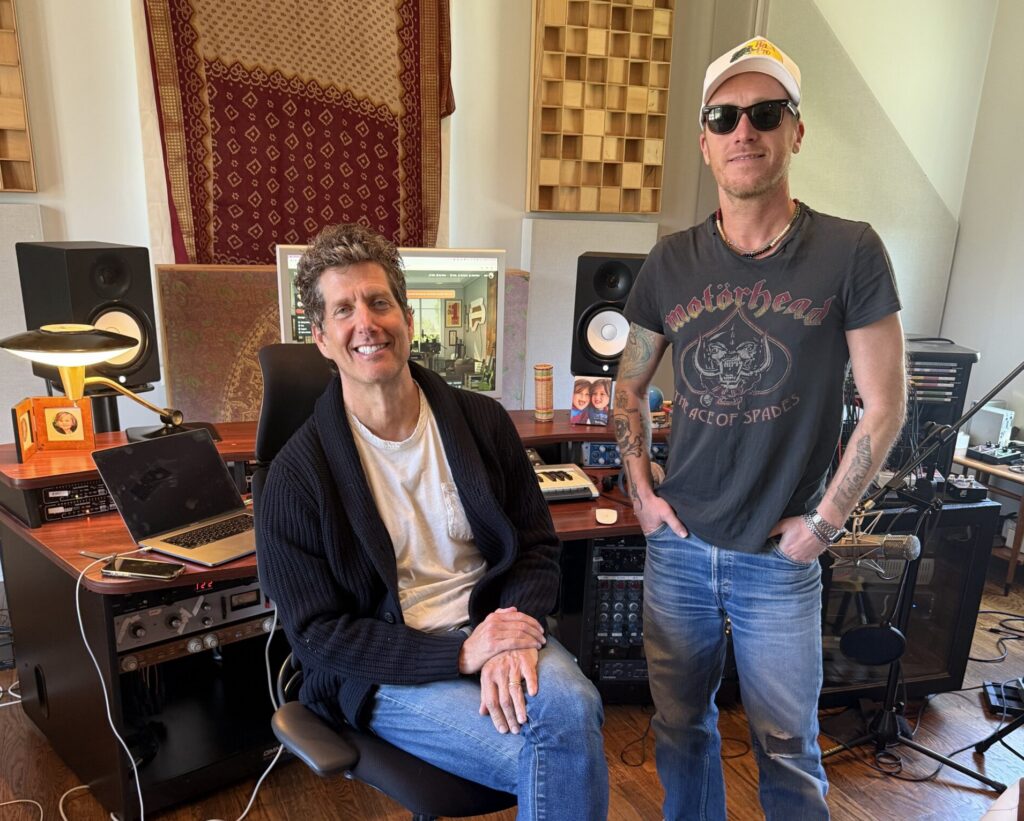
On my first visit to Kevin Griffin’s home studio in Franklin, the space already looks familiar. He has an image of his real-life workspace on the AI music platform I’m here to find out about. So I arrive ready to inquire about an eye-catching art piece I expected to see on the wall.
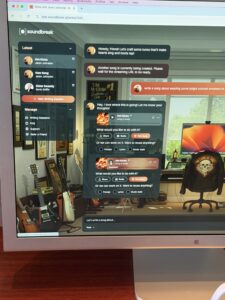
A screenshot of Soundbreak with a partial image of Griffin’s studio as the backdrop
“You’re pointing at the Mexican hand-painted ceramic pink deer head,” says Griffin, pushing his chair away from his computer desk. “On Soundbreak, the digital rendering of it gives it kind of a lazy-eye, Rudolph the Red-Nosed Reindeer vibe.”
Beneath the deer’s inanimate gaze, he holds pop, rock and country songwriting sessions for an array of projects. But he’s best known for his own band, Better Than Ezra, and its alternative rock breakthrough in the mid’90s.
Griffin’s been in the music business long enough to witness how it handles technological crises, like the rise of illegal downloading in the late ‘90s, followed by the ascendance of streaming platforms like Spotify.
“The labels sued them and said, ‘We will settle if you give us a piece of your company,’” he recounts. “Now the labels are making more money than they ever have in the physical era of sales. Meanwhile, the songwriters are getting screwed.”
(For further reading: Liz Pelly thoroughly excavated the inner workings and inequities of Spotify in her important, and widely covered, book, “Mood Machine.”)
After Suno’s launch grabbed attention in late 2023, Griffin spent a weekend putting its abilities to the test and was alarmed to discover that “this magical elixir of songwriting that we thought was impenetrable by computers suddenly was making these compelling songs.
“Gosh, it brought up so many red flags.”
These new companies hadn’t paid to use anyone’s music to train the song-generating AI models they were now selling subscriptions to. Before long, Griffin learned the major labels were quietly making deals to secure their stakes.
“So I can throw up my hands and say, ‘Here’s another thing that’s going to cannibalize my songwriting career.’ Or I can say, ‘I want to do something that advocates for me as a songwriter, and my peers.’ ”
True-to-life storytellers
What Griffin decided to do was create Soundbreak with a couple of young tech professionals in Nashville.
He would also need to get some of his peers on board, and envisioned an arrangement where they’d get cuts of paid subscriptions and share ownership of songs generated with AI.
AI has been a loaded topic in the songwriting world, a matter of public protest and private use. And with reason — it’s extremely hard to shake the notion that music made by machines lacks humanity. Nashville songwriters, viewed as experts in true-to-life storytelling, have been especially reluctant to acknowledge its growing presence.
But this was a member of their community doing the recruiting. That made all the difference for Jaren Johnston, who’s written hits for country superstars like Tim McGraw and Keith Urban and who leads the southern rock trio Cadillac Three. Johnston and Griffin have known each other for years, and Johnston jokes that when he got a text from Griffin asking to meet for coffee, he was skeptical about what Griffin wanted. And he says the techie pitch he received kind of “blew my mind.”
“‘You’ve got this unique IP, this intellectual property, that is the way you write,’” Griffin insisted to him. “‘Let’s have a thing that you control, that you can monetize.’”
And Johnston like the fact that Griffin was all about “the right way to do it.”
Soundbreak’s co-writing setup
Before Soundbreak could launch in February, Griffin and his small team tried to work out the kinks with the dozen writer-artists who initially signed on to license their signature styles. (The number has since grown.) No self-respecting hit-maker would approve an AI model bearing their name that churned out … crap.
I asked Griffin and Johnston to walk me through how it works. Griffin pulled up the site on his desktop, and scrolled through the menu of songwriters, which summarized their best-known compositions, accomplishments and sonic identities. We opted for Johnston, whose 3D studio likeness materialized before us, complete with No. 1 hit plaques on the wall.
Griffin let me choose the song topic. “Bright-colored kicks,” I improvised.
He elaborated on the theme slightly as he typed: “a song about wanting to wear some bright colored sneakers to counter a cold winter day.”
Users can provide as much guidance about the tone of the song, instrumental textures and vocal and production style as they want. Or contribute their own lyrics or melody. Or see what they get in the first go around and refine the prompt.
Rather than steer too much, we opted to see what Johnston’s AI model would default to.
The two options it spit out leaned towards southern power-pop and soul, both more pensive than I expected for a song with the goofy title “Hot Kicks.” But pensiveness and nostalgia are Johnston’s wheelhouse.
“It’s actually really on brand,” Griffin affirms.
And how does Johnston feel about what his AI model just cooked up?
“If I was in a writing session with somebody and I came out with that, I’d be like, ‘Baby, you gotta hear this!’” he grins. “And my wife hates everything. And she’d be, like, ‘Hell yeah, that’s great!’”
His wife has played around with his AI model herself. But Soundbreak users are more likely to be fans who don’t actually know Johnston. On the platform, they can experience an approximation of co-writing with artists they admire. And if the resulting songs they upload catch the ear of their virtual “co-writer,” they may receive human feedback.
“Like, when I thumbs-up a song,” Griffin explains, “it gets a badge on it that says ‘artist approved.’”
And for him, having a say in how AI’s being used is exactly the point.
Copyright © 2026 WPLN News