
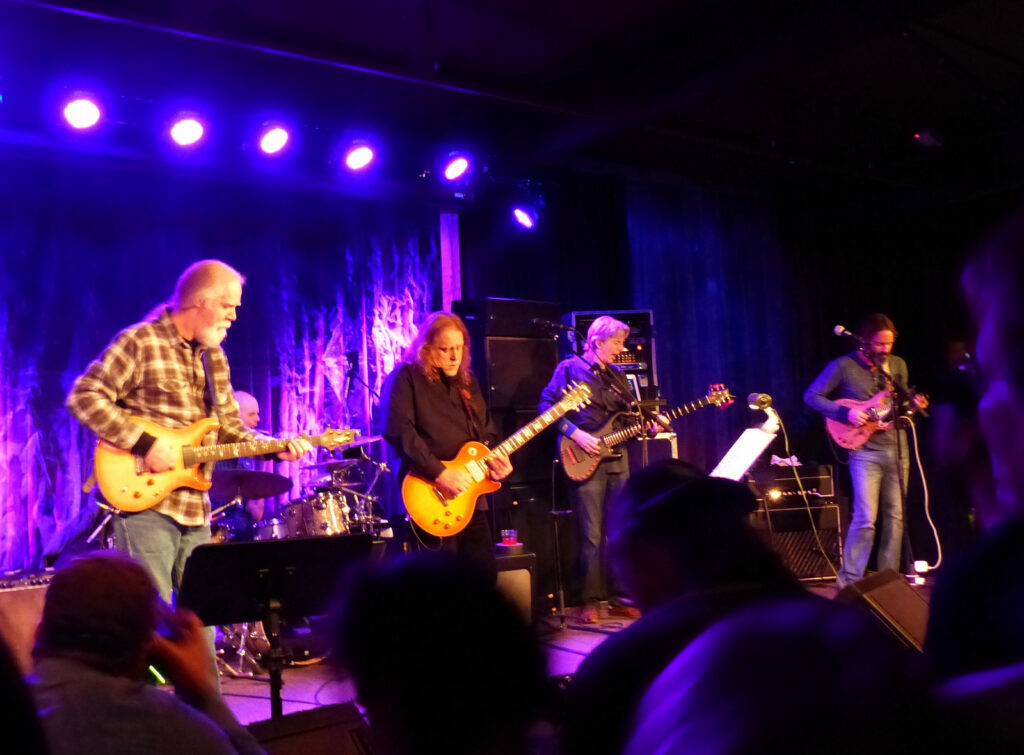
If you’re a fan of rock music, especially that of the improvisational or “jam” variety, I’m willing to bet money you’ve seen Warren Haynes on a stage in the last 30 years. The veteran singer, songwriter, guitarist and philanthropist has played with The Allman Brothers Band, The Dead and at innumerable festivals including his own single-day fundraiser each December in his native Asheville, N.C. called Christmas Jam. It’s his long-running project Gov’t Mule that returns to Nashville on April 22 — local sister band Larkin Poe is opening at The Pinnacle — but Haynes has also released a solo record called Million Voices Whisper, plus a set of stripped-back recordings called The Whisper Sessions, in the past couple of years. He really doesn’t quit, and doesn’t intend to.
I was honored to connect virtually with Warren Haynes — who’s also inspired a custom Gibson Les Paul guitar, notably — between his solo tour that hit the rural Tennessee venue The Caverns in March and this April Gov’t Mule gig. We spoke about staying fresh and on one’s toes in terms of songwriting, appreciating the “lifers” for whom music is never just a phase, his charitable activities plus cherished memories of working with founding Grateful Dead members, the late Phil Lesh and Bob Weir.
Catch the full On The Record: Warren Haynes here or wherever you stream podcasts.
Million Voices Whisper and Whisper Sessions
Celia Gregory: It feels like you’re just dropping content nonstop. You have some stripped-back sessions, versions of your newest full-length that came out in 2024. You’ve also since released a deluxe edition of that Million Voices Whisper [LP]. Why did you decide to take it acoustic on record? Not just performing those songs out, but why did you want to pull back some of that full-length and treat it that way?
Warren Haynes: Well, it kind of came about by accident. The way it started is we were doing these videos just for promotional content, and I did a few by myself and I did a few with Derek Trucks and we were choosing different settings and mostly set up in houses with remote recording and filming. When we were listening back to some of the performances, it was like, you know, they’re pretty charming in their own sort of way. And at first I thought the hardcore fans would really like it, and then it kind of seemed like maybe anyone that likes stripped-down versions of things would enjoy kind of hearing where these songs start out before they get turned into full production.
Songwriting
CG: I was going to ask you about your songwriting process over time and if the way you pull together ideas into songs, both as a lyricist and as a musician, has changed. Or do you have a tried-and-true process to be able to turn ideas into what we see here as a track list?
WH: No, I try to avoid falling into the same patterns all the time. As an example, I used to have a — it wasn’t really a rule of thumb, it’s just something that I noticed that most of the slow songs and mid-tempo songs started with a lyric and I added music later. Most of the up-tempo song started with some musical hook and I added the lyrics later. But in the last six or seven years, I’ve been kind of intentionally trying to do the opposite of that, just to not get stuck in a certain routine or pattern. I think as any songwriter grows, you want to kind of shift gears and find new paths and not rewrite what you’ve already written in the past.
For me, having written a lot of, let’s say, non-positive songs in the past, I wanted to kind of focus on the lot of the things that are really important to me at this point in my life. A lot of this started with the COVID lockdown because I was doing so much writing during that time period and I really didn’t want to write a bunch of songs that were so depressing that five years later I wouldn’t want to hear them. And so I just kind of changed my mindset and started writing about things that were important and for me that was a little bit different, because people have asked me in the past, “Why don’t you write more happy songs?” And my answer was always, “Because when I’m happy, I don’t feel the need to write a song.” And that’s most of the time, you know? I think I’m probably happy most of time. But writers have this luxury of being able to tap in to whatever’s eating at them and kind of write it away. And so my whole life has kind of been doing that. Recently, I felt like I just needed to explore other directions.
CG: I like the idea that it’s not just happy versus sad songs or even related to tempo, but what’s important to you. What would you say that is now that’s emerging in the music you’ve been writing in recent years?
WH: Family, personal relationships, being able to work again after so long of not being able to work, touring and performing and recording and all that stuff. I think I can speak for everybody in the music business. We were all scared that things were changing permanently. And that was frightening. And so at that point, I’m thinking, “Well, you got to figure out a way to move past it,” what the future is going to hold, but also just it just brings to light what’s really important in your life.
Southern heritage and investment in home
CG: When I think of a thread in your music without labeling it, all the different music you’ve made and bands you’ve been in, it’s great American music. Sometimes it’s easier to define with labels and to put you in a bucket. But I’m thinking about your heritage and being from the southeast and continuing to live and work and invest in your home [Asheville, N.C.]. Can you speak to that a little bit, maybe like Southern identity and American identity as it emerges in your music?
WH: Well, I think it shapes all of us, where we’re from, and that also carries over to the musicality. Especially when I was growing up, regional music was very important, even more so than it is now. Now with the internet and modern technology, a young musician can access any music from anywhere at any time. But when I was growing up, we were very influenced by the local musicians and the regional musicians and the kind of music that was made within a few hundred-mile radius, you know? And there were a lot of great guitar players where I came from that kind of taught each other, a lot a great songwriters that kind of taught of each other. In that way, I think what I do has always been influenced by where I’m from.
And also in the way of just growing up with this inherent feeling of where you came from, do you belong, how do you belong? How do you fit in in other places? It’s a growing process for anybody because when musicians reach a point where it’s like, “OK, I gotta go to another environment and feel what that’s all about. I can’t just stay where I am,” especially. Asheville at that time. Malcolm Holcomb, who was one of the songwriters that that mentored me when I was a kid, I remember him saying, “You got to get out of Asheville. You can’t just stay here This town is like quicksand. It’ll drag you down.” Of course it’s different now because now people move to Asheville for the scene and there wasn’t a scene back then, it was underground, but I think it’s amazing now that Asheville has blossomed into this place where musicians can go and find a scene…When I first started touring, late ’70s, early ’80s, people would say, “Where are you from?” I would say, “Asheville, North Carolina,” and nobody had heard of it. Now everyone has, which is fantastic because it’s a town that deserves that recognition. I’m very proud of my home.
CG: Yeah, and when I say continue to invest, it’s one thing to stay put and say, “This is where my creative community is growing around me,” but to invest in such a big way because there is still so much need. Like it could be a thriving sort of hippie-hipster mini metropolis in the mountains, but there’s still a lot of different classes and need-based [efforts] in your Habitat For Humanity work. We’re talking millions now you’ve raised for that organization in Western North Carolina, right?
WH: They’re a wonderful organization and we’re also working with BeLoved Asheville, which is a wonderful organization. We’re continuing to kind of stretch out and reach out and try to discover different local and regional charities that we can be involved with. The Christmas Jam, which I started in 1988, in the very beginning we made virtually no money and whatever money we made, we donated it to a charity. We picked a different charity every year. But then somewhere along the line, early on we discovered Habitat and kind of stuck with it. I’ve always been a fan of Jimmy Carter and especially his philanthropic work. And we could see where the money was going. We could see the houses that we were building. In a lot of charity situations, you just wonder how much of the money is actually going where it’s supposed to go because so much is spent on promotion and doing all these things that charities do that doesn’t translate to the actual work. I love the fact that Habitat was transparent in that way. BeLoved Asheville during the flooding with the Hurricane Helene did amazing work. And so all these organizations need all the help they can get.
I’ve encouraged young artists and musicians and bands [that] it’s not as hard as you think it is to give back, you know, in the case of what we do. We’re just doing what we do every day, which is playing music, and turning that into building houses for people that can’t afford them. And the music that gets made as a result is phenomenal because there’s something about playing for free, playing for charity, playing for a cause, that elevates the music in an unexplainable sort of way. First off, it reminds us all as musicians and artists what we started doing this for in the first place. Before we thought about making a living, we did it for the love of music.
Celebrating music “lifers” and music discovery
CG: I think about the people that you’ve had on this most recent record, including Derek Trucks, of course, your longtime collaborator, but also Jamey Johnson and Lukas Nelson. There’s always a blend for you of peers and maybe people you’ve mentored over time. I want to look back and I’ll get to that, but looking forward first, what’s encouraging to you about the music business right now? Or maybe we’ll just say music in general, as you’re still experiencing it and helping push people forward?
WH: Well, I think what’s encouraging right now is seeing bands and artists that are looking at their own careers in a way that they’re not patterning themselves after a commercial success. They’re just making the best music that they know how to make and developing an audience accordingly. And hand-in-hand with that is looking at it as something you’re gonna do with the rest of your life. There was a time period when I questioned the current pop music and even on the fringes as to whether the artists and the musicians and the bands were considering themselves lifers. You know, like a lot of people were in bands going, “I’ll do this for five or 10 years and maybe I’ll do something different.” I’ve never understood that philosophy. If you’re bitten by the music you never go back. [Laughs]
CG: It’s not a phase.
WH: It’s not a phase. And I think for some people it was for a while. Now I’m getting a different sense of that. And it’s encouraging that people have the outlet to do whatever they want to do. It is a little discouraging that the business has changed to the extent that you have to be able to promote yourself to a certain level to even be recognized. And no booking agent, no manager, no record company is going to sign you unless you have X amount of followers. And that’s different than the old days. In the old day, if you were really good, then somebody wanted to sign you and prove how good you were. But now the proof is numbers and that’s a little distressing.
CG: And even on the radio side, it’s like, we do things differently because we can, because we’re a public radio station now fully-funded by the people, right? No government pennies to count. But we still do have to pay attention to trends. And you’re just like, “Well, this isn’t the full story,” you know? The currency used to be, “I’ve seen this band live. Trust me, here’s a tape and come with me next time they’re in town” and that sort of legitimacy based on the full music experience, not just some stats based on a broken business model.
WH: Yeah, and public radio is so important. I’ve spent so many hundreds and hundreds of hours listening to public radio because you can discover music that you’re not going to discover anywhere else. My whole life has been about that. I thankfully had two older brothers that had great taste in music and turned me on to a lot of great music. I’m not saying we didn’t listen to the radio, to like AM radio and FM radio back in the old days, we had no other choice. But you also discovered music word of mouth. People would say, “Hey, have you heard this? It’s awesome.” And you check it out and then you tell somebody else about it. What you’re saying is 100% correct. And I think that’s why public radio is so important.
Memories of Phil Lesh and Bob Weir
CG: You spoke to looking ahead and also appreciating what life means to you now. But you’ve made music that I love and you’ve also played alongside some of my heroes and we’ve lost a couple real good ones in recent years. I think talking about that live music experience and the affinity you build with people you share a stage with, if you’re an artist, but also people in front of you. That community sort of unmatched, especially in the jam rock and Blues communities. Do you have any stories you’d like to share about playing with The Dead, maybe about Bobby [Weir] or Phil [Lesh], specifically?
WH: Yeah, I mean I love both of those guys. Phil is the one that brought me into that whole scene and I am forever indebted to him for that and all the great music that we played together. Phil opened my mind about what music can be, what it should be, what it should not be. And what I mean by that is he was the most open-minded musician I’ve ever met. He put absolutely no pressure on the music. It was what’s happening in the moment. If it gets away from us, that’s fine. There would be times when we were in the middle of some intense jam and it might kind of go off track a little bit and I would look at Phil and he would have the biggest grin on his face. He couldn’t enjoy it more. And my instinct was always to try to reel it back in and get it back where I thought it should be, you know? And that’s my first mistake is it shouldn’t be where I think it should. It should be a collective thing that’s happening and we’re just riding the wave. You can’t approach all music like that, but you can approach improvisational music like that, especially if you have the right audience. And I thought I was extremely open-minded until I met him and then I realized I’ve got a ways to go.
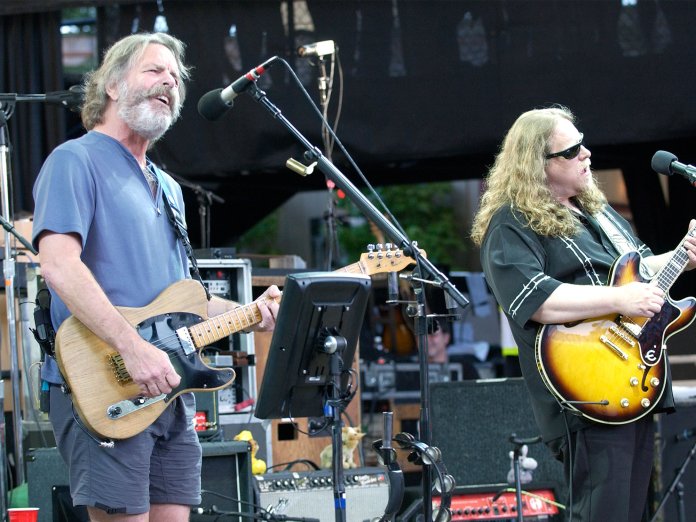
WH: It was through him that I met all the guys in The Dead and eventually did the two tours with The Dead. Bob was such a sweet person and his philosophy and his attitude about life was always very positive, always open. He lived every day as if it were a new day and he approached every song and every performance that way. He never wanted to look back at what had been done before. He always wanted to think, “OK, well, how are we going to do it now? What feels right, right now?” When I did the tour, I guess, 2009, the second one I did, we rehearsed for a month in San Francisco. We spent more time rearranging the old songs and working on harmony parts and background vocal parts. In some cases that we wound up not even doing [live], but it was just fun for them to take these songs that had been in their catalog for all this time and reinvent them and think, “How could we approach it differently?” And Bob would always have these ideas [like], “Hey, when singing these parts, why don’t we sing it like this?” And then we would spend hours doing that. Not because it was necessary, because it is fun, you know, and I just felt that it was really beautiful.
CG: The joy of it, the way you got into it in the first place, and maybe, too, this elusive balance of tight and loose, right?
WH: Absolutely.
CG: The discipline of it, but also the letting it flow through you, which is the sense I get when I watch you play.
WH: And they, you know, they both came to Christmas Jam. Phil came many, many times. Bob came and wanted to come again. We had been talking the last few years about him coming back again. And it was always, “What am I going to do? What can I do different? Yeah, I want to come. Let me think about what it’s going to be.” And he would always wind up doing something there that he had never done before.
CG: Warren Haynes, I’m not going to keep you…I just can’t thank you enough for the arts you’ve contributed to, like I said, the great American music that we get to appreciate. I feel like it’s some of the best of us is the ways we get to enjoy and express ourselves through art. So thanks for your place in that and continuing to make what you make.
WH: Well, thank you, and I appreciate your assessment of what you consider the blend of influences that I have to be, because the one thing they all have in common is, for the most part, American music. It’s blues, it’s soul music, it Black gospel music, its folk music, it’s country music, and it’s rock ‘n roll, it’s jazz, all these things that came out of America. Combined together. Now, it doesn’t mean I wasn’t very influenced by the British invasion. I obviously was. But America should be proud of what we’ve given the world musically.