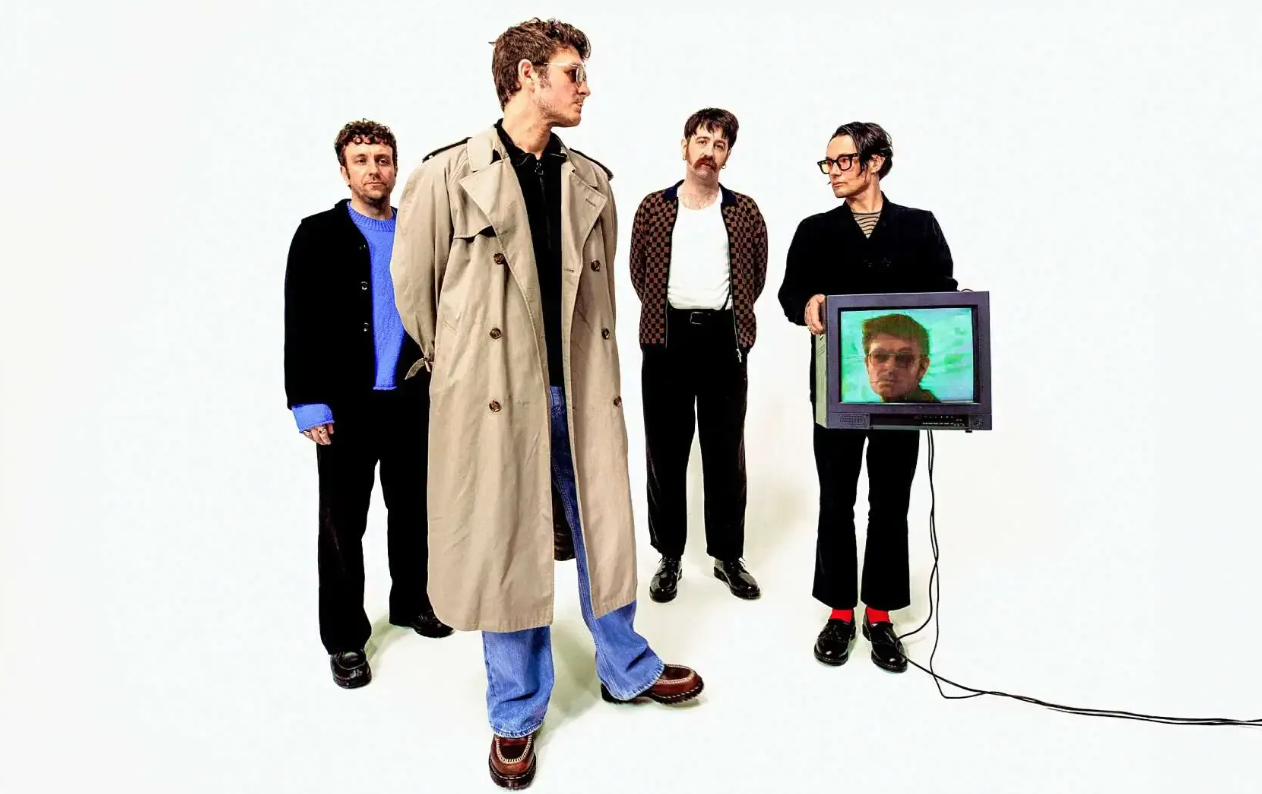
Leeds band Yard Act recorded their third LP, You’re Gonna Need A Little Music, in two separate, months-apart sessions in the U.K. and LA split by a tour opening for The Hives. The result is 11 tracks that jump around from the group’s trademark English snark — what singer and lyricist James Smith says is the album’s “cynical core” — to more sun-kissed, optimistic melodies all recorded live in-studio together.
We got Smith and bassist Ryan Needham On The Record with WNXP before the record release date, July 17. The first American leg of their tour in support of this full-length does not include Nashville but our fingers are crossed for 2027.
Anticipation about LP3 release
Ryan Needham: It’s a weird one, isn’t it? I thought the third time around, maybe some of the excitement would have worn off or, you know, slight nerves. I don’t know. When you’ve made something, you just sort of hope that it connects and things do. Much better albums haven’t connected, so who knows? It’s with the gods now.
James Smith: Yeah, it’s weird, I don’t know, I’m more nervous than I thought I’d be, but I suppose that means I care. You kind of have two celebrations because you have to celebrate like when we came back from LA at the end of January that was kind of like popping champagne and all celebrating that we made this incredible thing. And then it drags on for months and months of waiting and arguing about mixes and then mastering, that takes ages to discuss, as well.
And also the thing is, our previous albums are still kind of having their own life now, those songs kind of still are out there in the universe doing those crazy things. And we get reminded about them every now and then. When that connects in an interesting way, or they still have their moments at a show or whatever. It’s kind of weird that you think that the [record release] day is the big thing, but actually it’s just sort of slowly sort of sprinkling out, and that’s kind of beautiful, you know.
Two-continent recording process
Celia Gregory: I understand some of it was recorded at home, right? But then in LA, is that where you put the bow on the thing and said, “For our part, we’re done. We’re done playing these songs”?
JS: Yeah That was the sun-kissed goodbye to the whole thing. I mean, it’s the first time we’ve done an album between two countries and two climates, I suppose. We took a sort of enforced gap when we were on The Hives tour. So we did the Leeds leg and then went on tour for a couple of months and then Christmas. So it was like a three-month gap pretty much…it was strange at first. I definitely struggled at first leaving an album half finished and found it quite frustrating. Obviously there’s more frustrating positions to be in than going on tour with the Hives. That’s a sugar-coated form of frustration, but it was like, “Oh, I’ve got all these ideas about this. I want finish this.” And after we let go of that… and coming back with fresh ears and fresh perspective in January in a different location it was it was amazing for the sort of psyche of the record. It gave it a deep sense of perspective I think to to be to have the core of it be miserable and cynical and gray and Leeds but then have this sort of sun-kissed optimism and hope on the end. I think that was important and that was LA all over, yeah.
RN: I’m glad we didn’t make a full LA record. Are you aware, Celia, of this? It’s a bit of a cliche — a cliche and a dream — for U.K. bands to go and make their LA album. I don’t know if that’s the same. I mean, you’re a lot closer than we are. There’s maybe an equivalent where everyone wants to come to Abbey Road from the States, I don’t know. But yeah, it’s not full LA…we weren’t sort of Laurel Canyon-y sort of jam band in it, but the sprinkle of sunshine, like James said, it was was much needed, I think.
JS: We had one rule, which was record the hand claps in Leeds because they would be too happy if we did American West Coast hand claps. So they were done in a dark church hall on a rainy day and it had to be like a Tuesday afternoon, no Friday morning hand claps on the West Coast.
RN: We’d written a few bits and bobs, a few songs and we were recorded with Justin Meldal-Johnsen. We had a few Zooms with him and the vibe was good so we kind of bit the bullet and was like, “Yeah, his guy gets it” and then he came over for two and a half weeks. He lives in LA, but he stayed in Meanwood near where I am now, in a little sort of hobbit hole in the woods. We went in with him and just thrashed through all the songs and he really pushed us to… he was like, “You guys have been playing around the world for the last four years together. You’re really good live and why have you not captured this on record? You should definitely get at least a big chunk of that down.” And that’s not like a reinventing the wheel thing for an album. But yeah, because we were born out of COVID and stuff, we historically sort of laptop hunches in the writing process. This way it was a lot different and a bit more old school, really.
JS: It was easier that we could try new ideas together and not have to sort of sit and discuss them separately or wait, you know what I mean? The process was so quick, but especially when we were demoing and we built the studio and Jay set it all up and rigged it amazingly so we could all be huddled in — well, we’d stand or sit in this big room all facing each other and do takes and then press play and immediately listen back to a really high-quality crystal clear recording of all four of us, what everyone’s doing, and and if you heard that taken it was so easy to then just tweak one or two things and try again in a very human way rather than using the computer to manipulate it to see if it worked. Because we did that a lot on the second record [Where’s My Utopia?] especially. Trying stuff would involve running it through the computer and sort of using the using the computer to slow it down or programming a loop in just to be able to pick up any piece of percussion and whack it into a mic really fast because we had all this space. Also, just writing the parts together rather than one person writing a part and everyone else thinking about it and about what they were going to add to it…I think it gave it a lot more propulsion as a unit. I think it’s a really unified record musically, and also I think everyone has expressed their individual sort of flair. But we go forward as one, which is important, you know.
“Six months of moods”
CG: James, you sound a little pissed off. Like from the very first single [“Redeemer”] I was like, “Oh, what are we doing here?” And then with the first song in the track order [“Empty Pledges”] I’m getting some ferocity, too. Do you want to speak to that?
JS: We wrote a lot of songs for the record, I think it was about 40 odd that kind of were written over a period of about nine months. A couple of early ones got through the gates while we were still in the back end of the Where’s My Utopia? tour, before we built the studio. But we had six months in the studio kind of interrupted. And your mood is going to shift a lot within a six-month period. We were definitely always committed to embracing, I suppose, my mood a little bit in terms of sort of lyrically and sort of where that lifts and the band would kind of rise to that and live with that. But we’d sit in that each day as we generated stuff and it felt like a way of working through whatever mood I was in. And obviously, yeah, I must have been very pissed off, God knows why. But like, obviously your mood shifts and that’s why there’s incredibly joyous music on there as well and then all the bits in between. We didn’t discuss a mood and then write to the mood, we kind of let the mood direct us and that’s six months of moods condensed down to 11 tracks, essentially.
RN: Sometimes we would have to take a lunch because the mood was too much.
JS: Yeah, we had to take a break. We had a mood break.
RN: We had many breaks, but other times we worked through the night because it was the opposite of that. It’s true what James says, it was very mood-based, I’ve not really thought about that.
JS: With Yard Act growing and especially playing to like bigger crowds and crowds that are aware of what we do, I’ve seen be personally affected by it, obviously, in that sense. It kind of changes you and it opens you up as a person a little bit more. I feel a lot harder than I used to. I think that’s probably combined with having a kid, as well. But I really feel my moods these days. And it doesn’t mean I can’t control them. You know what I mean? It doesn’t mean that when I’m angry, I’m stomping around, like very occasionally –I’m sure Ryan will attest to that. But I think I’m a lot more in tune with my mood than I have been. And I put that down to having shared incredibly vulnerable moments with strangers through music…it rips that cynical, sarcastic Band-Aid off your brain a little bit. And this is the first time I really had the chance to take stock of those moods within songs and not mask them as much. If you scratch beneath the surface of Yard Act records, there was always a lot of heart in them, but I think it was kind of masked by that irony and that sarcasm. There’s a lot less of that on this record because I think I found it easier to communicate more directly and express that within music and the band, because of our connection to each other, have risen to that. We all support what we’re trying and what it’s evocative of in that moment, I suppose.
“Janey Said”
JS: “Janey Said” is like a sad, reflective song and the care and attention that we put into the music of that together was like we’d never attempted anything like that ambitious before. And I think it really paid off. To me, the instruments on that tune really sound like they’re talking to each other and that’s sort of symbolic of us for…communicating through song with each other. And it’s interwoven and intertwined in them. You can put this on the internet. I’m incredibly proud of that piece of music. That’s not something that you can do with three strangers on the fly. That’s that comes from deep trust and understanding. And I think it’s a beautiful piece of music that we created together, that song. I don’t think that is across the record as well, but that one in particular is the one I mentioned.
CG: I thought, looking at the three albums together, the three full-lengths, that song is wildly specific. It paints a picture and it’s like, maybe like “Tall Poppies” [from The Overload] and “Blackpool Illuminations” [from Where’s My Utopia?], the little bit of the speak-singing, it feels like you’re being read a story aloud. But to your point, the musicality here felt different. So I love knowing the experience of that and coming together full band is really like an emblem of making this record together, full band. That makes me happy as a listener that my experience listening is what your experience was creating it.
“You’re Gonna Need a Little Music”
RN: The piano became kind of key, a sort of central thing in the studio. James’s aunt passed away and left it to him. We dragged it down the studio in the back of my Golf and got it tuned and, well, got it half-tuned, actually. But when we wrote “You’re Gonna Need a Little Music,” that was the beginning. James played pretty much all the piano on that. [To Smith] You kind of have been teaching yourself, right? And I think James finding his feet through working with his piano and stuff, and then “You’re Gonna Need a Little Music,” it was the first one. That song was all done in a day, really like start to finish. That’s one where we stayed late, you know, and the vibe was good. And maybe it dwindled a bit around lunchtime, and then we had a little break to get the blood sugar back up, and then, you now, that was a real ride in the studio. James, I remember you like, “I know I can do this!” and you were really pushing yourself and that piano came out and stuff yeah that was a real like it felt like an absolute solid day’s work when we finished that one you know it turned out really good. When you hear artists talk about songs like they’re just catching them in their channels and you do the thing and it’s written in 20 minutes, I think it’s normally a bit of a lie. But this one was a day and it just flowed really, really easily, it wasn’t a struggle at all.
JS: I remember it catching after we’d been in for a few hours and nothing had come. It was in one of those down periods where like we were sat and I started sort of knocking that little piano bit out. I remember [guitarist] Sam sort of brushing these chords out and then [drummer] Jay was playing a completely different sort of like slow sort or half-time drum beat over it and no one was even talking to each other. And then Jay just skipped the beat and started doing that disco thing. And all of a sudden everyone became really animated and Ryan was like hammering this light note. And it was like, “Record that, record that” and we just jammed it. The “You’re gonna need a little music” hook was there. And we put that in, but I wrote this sort of first block of lyrics and did a take of them. I didn’t know what I was writing about. It was this kind of like stalker-y song, like someone watching a light go on and off in a house on the opposite side of the street. And then we broke for something to eat. And I remember saying to Jay to delete that, I’m going to do some after this, and I wrote pretty much the whole of the verses and the whole story just poured out…it all fell out very, very fast. By the end of the day it was like, “Get the shakers on it, right, get that synth pulsing underneath,” it was very much like building it. I don’t know where 10, 11 hours went. We were just ecstatic. And it became the name of the album. I think that was one of those moments that you’re kind of fishing for when you’re writing…it was really special.
“Cherophobe Rock” and finding happiness on tour
CG: Do you have a fear of happiness? I had to look up the word —
JS: Cherophobe? No, I don’t. I think I’m OK with happiness. But I think a lot of people do. I think it’s a plague that is sort of spreading through the hearts and minds of society. I don’t know what the word is, but I’m sure there’s one and it’s probably German, the word where you kind of get a kick out of being miserable. I think people really revel in that because it’s easier, well, because it is protective, you know, it’s a defense mechanism, it is easier to embrace pain because it easier to find, I suppose. And so in the same breath, it’s easier to reject happiness. And be scared of it because it can let you down, you know. But I think that’s probably to do with the fact that we are kind of fed this lie that life is a straight arc and that you can achieve it by following what society wants of you. And people protect themselves very early when they’ve had happiness and had it taken away. Because it reduces risk and it makes a more manageable life to not go to that vulnerable place again.
But you can’t have the highs if you don’t, you know, the lows come with the highs part and parcel. And it’s more about being able to sort of take life raw and as a whole package rather than thinking that if you’ve had the good times snatched away, you can get back to them and also be aware that if you do get back to them, they may go again. As Ronan Keating once said, “Life is a rollercoaster.” I do experience happiness quite regularly and I’m not afraid of it.
CG: Ryan, what’s one way to not fear happiness but embrace happiness leading into touring again? You guys have really been road dogs for a while and what’s maybe core to your appreciating the total package when you’re on tour?
RN: First thing we’re doing, we’re flying straight into Minneapolis. So we’re going straight back to Paisley Park again. Will they give me free entry now that I’ve got the Prince tattoo? I doubt it. But yeah, me and Chris [Duffin, keys], we did the basic package last time. We’ll get in the $250 package this time. I think you can go into Prince’s living quarters. So basically we’re doing more on tour, more wholesome stuff. The world’s insane at the minute. Who knows if we’re ever going to gets to go to any other countries after this run. So I’m going to really make the most of it this time.
JS: We’re off to Serge Gainsbourg’s house, aren’t we?
RN: Yep, that’s another one in Paris.
RN: A weird one that I went to actually that you can’t pay for, Nick Drake…Nick Drake’s mum used to live in Henley-on-Thames, which is sort of down past the Midlands near where I’m from. Me and my friend got the train there and you could go and knock on and his mum would make you a cup of tea. You couldn’t pay there to go in there but we went and she showed us his room where he wrote Five Leaves Left. It was wicked.
CG: I hear you maximizing time on tour to be culturally — maybe not superior to other rock bands, but culturally invested in the places you’re going. And I think that’s a particular kind of tourism that, say this does just go belly-up, this dream that we all have, then you did you did it right.
RN: We went to Leonard Cohen’s house in Montreal. We normally tie it in with a run. We’re kind of run freaks as well.
CG: I was going to ask if you’re still on that tip, but I didn’t want to embarrass you if you’d stopped. You know, I stop and start all the time.
JS: This is the best combination of those two things. We ran 10 miles to Holger Czukay’s [of German band Can] grave in Cologne. Yeah, that’s probably like the best combination of visiting dead heroes in the city they’re from, whilst getting exercise in. That was a good one.
CG: Whoa, 10 miles out and back or 10 miles one way?!
JS: We ran back into town to make it 10 miles and then we got the train back to the venue for soundtrack because we realized we had run too far. It was one of them things where you look it up on Google Maps and it says it’s only so far and then once you start running it readjusts and adds like eight kilometers on and we’re like “OK, right, we’re going to be in a rush now, but we said we’ll do it so that was the plan.”