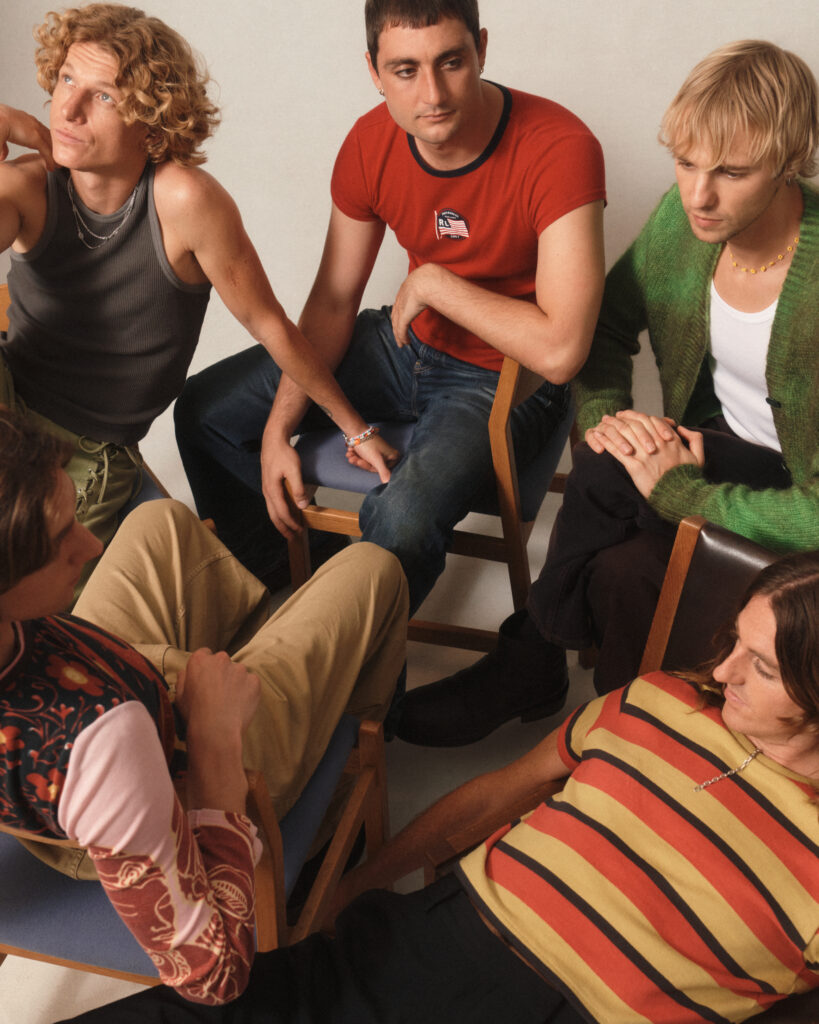
Patrick Hetherington of Parcels was a few minutes behind bandmate Louie Swain and their tour manager on the day of their Nashville show, as he was coming to WNXP separately from Carter Vintage — a local guitar shop to which he hoped to return after our interview in-studio. The singer-songwriter and multi-instrumentalist, one of five in the dynamic Australian band, raved about the guitar he’d found and wanted to buy before they had to soundcheck at the amphitheater downtown. “It’s like a bigger hollow-body, a more country style acoustic guitar.”
From stage at the show, Pat confirmed going back to get the guitar: a memento from Music City, and from the United States, which he and Louie agreed is “a very inspiring place.” Nashville was the final non-festival set they’d play on their quick sprint two-week tour in the states, in support and following the September release of their third LP LOVED.
Hear Pat and Louie of Parcels On The Record with WNXP and read some excerpts from our chat.
Taking a joyful approach
Celia Gregory: It’s been some trying times right now globally, but here, too, and that’s why I thought a new Parcels record was right on time, like the joy that you bring to music making and performance. And I read somewhere, that’s sort of a mandate right, or a mission of the band. It’s not accidental, it’s part of why you do this to spread joy.
Louie Swain: Yeah, I mean I think with this album it was a decision of let’s embrace that side of the band and kind of really go there for a full album because usually we try to… I think the last albums we’ve done we’ve tried to do everything at once and this time it felt kind of cool just to focus on something.
CG: OK, what do you mean everything at once versus the focus? Is it a musical focus or a thematic focus?
PH: Yeah, both, I guess. Just trying to be pure with our approach. I suppose in the past we maybe we felt like we needed to spread out and jump from one sound to the other and from a lightness to a darkness and that was really fun, that’s still really fun. But yeah, this album just felt right to go like, “Let’s take the path of least resistance and do what we’re feeling in the moment which was like a joyful approach.”
I think the writing is always coming from a place of, like, not thinking and just doing what comes, what feels right. And there are three of us in the band writing songs quite individually, usually, starting with ideas and we just kind of create a whole pile of ideas. And then this next phase of like bringing it into the band, deciding which songs we’re going to do, how we’re going to arrange them, produce them, and kind of creating a record. Maybe that’s what I mean with the path of least resistance. In that phase in which songs are coming most naturally, what works when we sit down in a room and play live together, sing together and don’t force anything?
Band trust and history
CG: I think when I watch you perform — and even like the Tiny Desk concert recently out for NPR — you seem to express joy with audience but also with one another. It seems like there’s a lot of trust involved in the Parcels sound being what it is. So I guess maybe elaborate on that a little bit, the trust you’ve developed as a band over the years.
PH: Yeah, that’s the base of the whole thing. That’s really the main sort of project of Parcels is our relationship. It’s very strange and intense, behind all the music is this five-man kind of marriage of worlds and people. We’ve known each other since we were kids and we live together and we work together and we make music together. So it’s everything, a lot goes into that and a lot comes out of it, I hope.
CG: Because you moved continent together, right? All five of you together moved from Australia to Berlin and you’re still there?
LS: For the most part, two of the boys have moved back to Australia now, so now it’s a kind of new phase of the band where we are on different sides of the world some of the time, and yeah, working out how it all still goes.
CG: Well then touring can feel like a reunion of sorts, huh, when you get to be together?
LS: I think our relationship is actually the best when we’re on tour because we’re in the same boat. And when it becomes a bit of a grind and we’re all tired and have been on the road for a while, we do kind of come together. In the end it is just the five of us, let’s get through this thing.
Harmonies
CG: So much of the magic for me is your vocal harmonies. Especially when I see you live and I’m like, “How are they so practiced in this and good at this?” Did you start singing like that as soon as you formed this band? Was it always key to layer harmonies like that? Because I can’t think of a single song where there’s not that richness of all four of your voices together.
PH: Before this band, we played in other bands as teenagers since we were 13. We jumped around bands and different styles and stuff and one of the main phases was playing like folk and bluegrass music and busking on the street. That’s where we learned to sing together and sing loud.
LS: Yeah, we had to be quite loud because we’re just playing down at the markets on the weekend and there are lots of things going on. So we really wanted to be heard, so we’d just yell these harmonies together. But I think that was definitely very crucial in in learning that between all of us.
CG: To learn your own voice, especially as one adolesces, is a thing but then to grow into this vocal arrangement together..I mean it’s just gorgeous. So do you have a coach now or do you just lay all these harmonies on yourselves?
LS: No, it’s more of an internal process. We did have a singing teacher for one month.
CG: He got axed?
LS: I think he actually taught us a lot, but yeah. [Laughs.]
Writing and recording songs for LOVED
CG: Tell me about the recording process for LOVED. How much time did you spend? Where were you?
LS: We did it kind of over about a year and a half. We met three or four times in different parts of the world. We did early sessions in Berlin, a few in Mexico, some in Sydney at the end. We kind of had a bit of a method towards the end, it was very much like tracking together as a band, getting the instrumental foundation and then doing these fun vocal sessions, the four of us around the mic. There were definitely a few of those sessions that, like, we spent a month in the studio and kind of got rid of everything afterwards.
CG: Really, so the editing phase was also pretty important to what we hear on LOVED, there was some stuff left on the cutting room floor.
PH: There’s always…there are just so many songs with us. Like I say, there’s three of us writing.
LS: Pat writes about a billion songs a year.
PH: I write a lot. A big part of making an album is just realizing what are the songs. And once we realized what’s the sort of sound and feeling, it was very easy. It took like a year of kind of not getting anything. Maybe we used one or two songs that we built up over a year. And then the last two weeks in Sydney, we tracked 80% of the album from songs that we already had, a couple of new ones. But yeah, it was just locked in. It was a very clear picture by then.
CG: So maybe the time it took in the experimenting before led to that point?
PH: I think it was all important but, yeah, it is a weird way when you quantify it like it did all happen at the very end after so long.
CG: I never know how much place matters. I’ve never recorded an album myself, but mayou felt more at home there?
LS: Could have been, yeah. There was something about being in Sydney, actually, we felt motivated to work in a way, because it’s a hustle culture in Sydney. Everyone’s working very hard. But it was also a very beautiful place to be, generally.
Synths
CG: I don’t know, creation phase-wise, if you normally start with keys and build from there a guitar part.
PH: I never really think about it. I don’t know. I don’t really think about the keyboard. It feels like we’re one unit in the studio. It’s like, what is everybody doing?
LS: We often, well, at the end of the sound, we do a kind of synth session where we plug in a bunch of old synths and we do these takes over the songs, two or three of us playing keyboards the whole time and just like building a textural world. So that’s kind of become something we like to do on records now.
PH: Yeah, that’s really fun. That’s like the post-. So we’ll record live, but then we’ll play, like, maybe we’ll have a piano and a viola, so a couple of analog keyboards and guitars, bass and drums. And we’re all like a rhythm section. The whole band is a rhythm session. We’re just supporting a groove and from song to song, like improvising more, maybe adding more information or less. But then afterwards we do the ambience with synths over the top.
CG: I’m thinking about how percussive you are as a band, not just the people playing percussion instruments, but the overall sound.
PH: That’s fun. That’s exactly how I see the keyboard. I mean, especially live — you end up, Louie, doing more of the synth world live.
LS: When either of us is playing like a piano or Rhodes or Wurlitzer sound, what I’m trying to do is be the guitar, as well, and interact on the guitar’s level. Often I’m just mirroring what Jules is doing exactly and then there’s all the pads and the strings and things like that.
PH: It does feel like percussion.
Rehearsing and playing bigger shows
CG: I don’t know what rehearsal is like to get you to that place that you’re tour ready, but it you make it look easy. Is it grueling? Are you guys all very exacting and hard on one another?
LS: It’s not a healthy pattern the last couple of years, but we’ve like left rehearsals very late before tours. So we get together like a one week before the kickoff and just slam ourselves to like get it together. Whereas when we were young and had heaps of time and not much to do, we would rehearse for months and that was, you know, time consuming, but maybe more pleasant.
CG: But also maybe you don’t need as much practice. Is that a leap?
LS: No, that’s true. Yeah, we’re more confident now that, when we get in a room, it’s gonna sound good quickly. But I think being creatively inspired and having new arrangements to show people a new journey each show.
CG: I’ve seen you in a big festival setting, I’ve see you in club venue, tonight you’re at an outdoor amphitheater. Can you explain what you see from stage as the transfer of energy? I’m trying not to be so hippie about it, but it does feel like a special interaction with the band and the audience at your shows. And it’s not just because it’s like late night Bonnaroo and everybody’s feeling it.
LS: Were you at Bonnaroo?
CG: I was at Bonnaroo. So yeah, what are you experiencing from stage when you can see people out there moving to your music?
PH: It’s so different every night. This last tour in Europe and America, these venues have gotten a lot bigger than what we’ve done in the past. And sometimes it’s a big full arena full of people, which is totally new and different experience to playing for like a theater or something like that. And so the first thing was like, “How do I get out of my head and [be] present with this many people and kind of connect with this thing?” I’ll speak for myself, but I think we all had it a little bit…like there’s a barrier between me and this mass of people. There are so many people that there’s kind of different energies going around, but if you have 3,000 people in a theater and everyone’s like come together, it’s one feeling, you know. So now it’s like, sometimes it’s pretty hard to grasp what’s going on out there. I can get lost in my head, like, “Is this working, do people like this? Am I singing good?” And then the whole show becomes an anxious kind of trip. Which at the same time we’re playing very positive songs, [Laughs], it was a weird experience.
CG: You’re spiraling.
PH: Yeah, we spiral sometimes. But now I think we’ve settled into this tour and this size of venue and it’s become really fun and I’m becoming more and more comfortable with it. And yeah, on those nights where it feels like we’re all in it together, it’s such a special feeling. Everybody comes to the show for a different reason, you know. Some people come to just party and dance and get wasted or whatever, and I love to see that. And some people are just closing their eyes and crying, you know, and some people just sitting up the back just like waiting to leave. Just chilling.