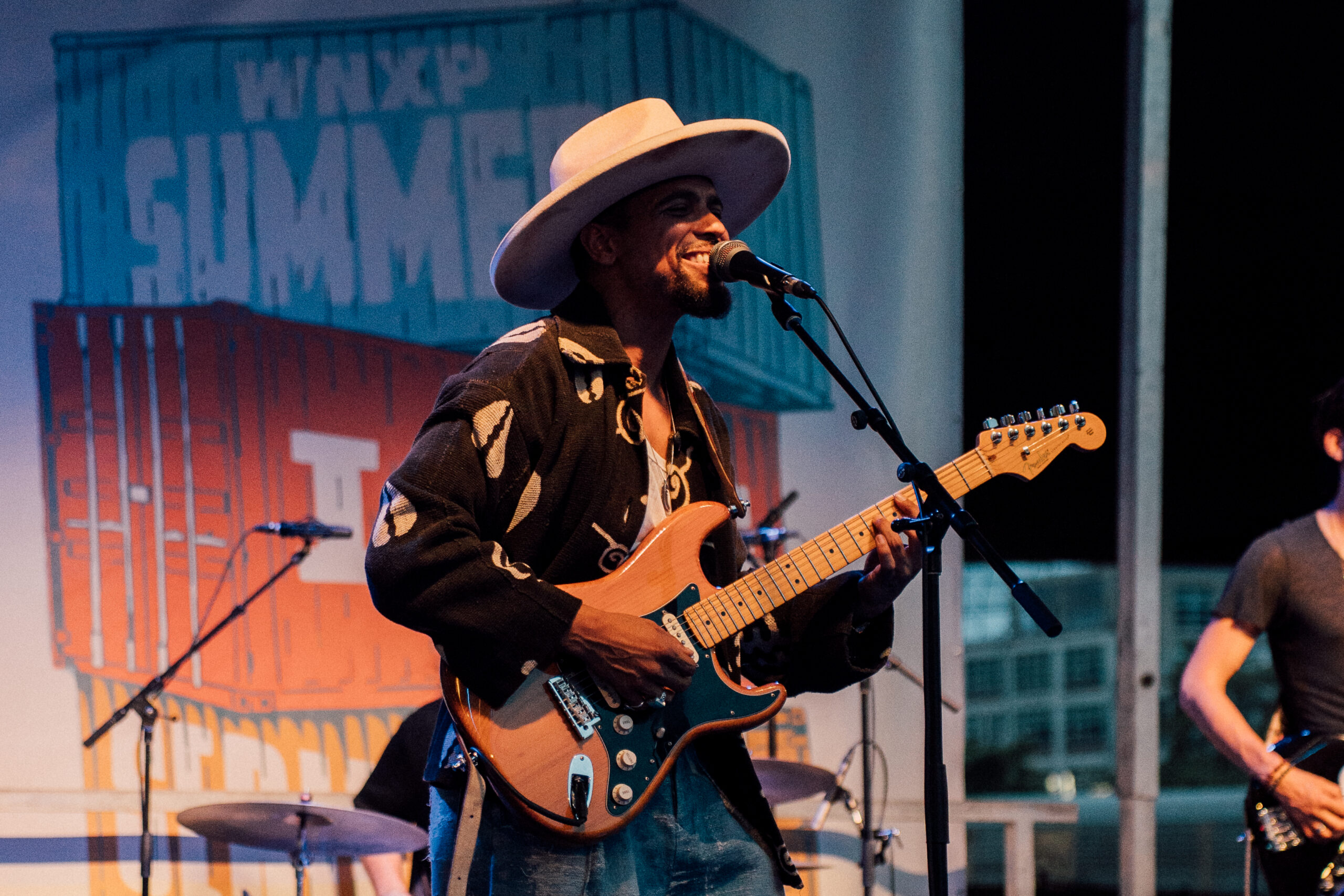
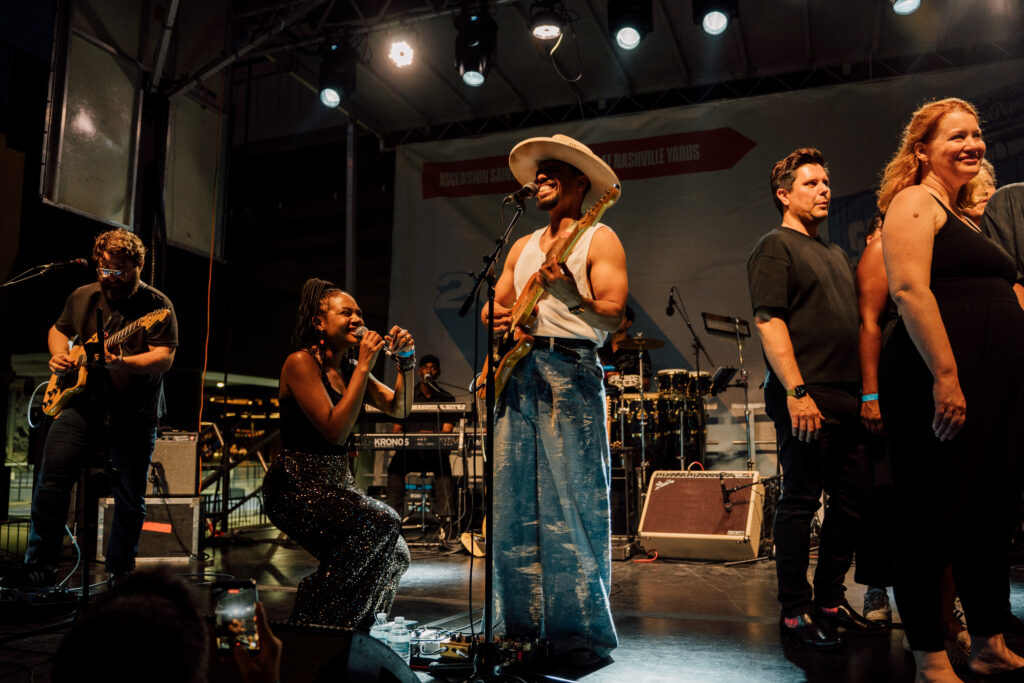
Devon Gilfillian’s third record, Time Will Tell, was recorded at the historic Music Row establishment RCA Studio A live to tape with trusted collaborators from past projects. The self-produced LP dropped on the same day WNXP showcased the Philly native, Nashville-based artist and his band for the first show in our Summer Line Series. Replete with special guests including Allison Russell, Madeline Edwards and members of Nashville’s Portara Ensemble chamber choir, the free outdoor concert on June 26 served as an unofficial summer kickoff, a record release celebration and a birthday party for Gilfillian’s drummer/manager/co-producer Jonathan Smalt.
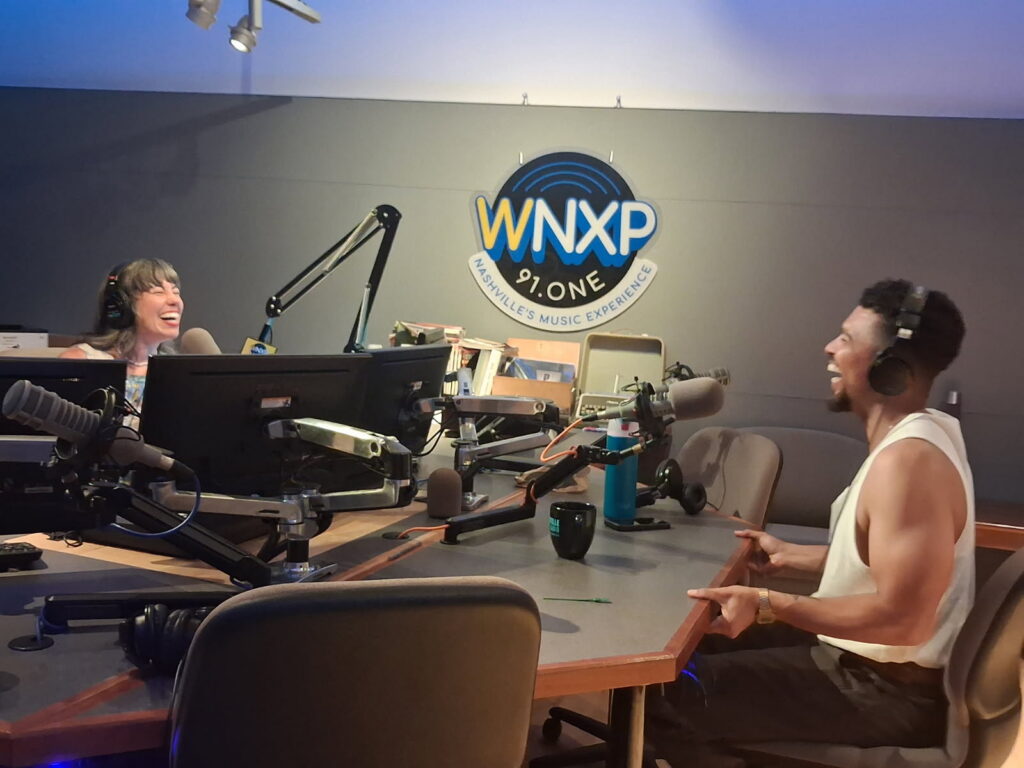
Prior to the release of Time Will Tell, we hosted former Nashville Artist of the Month Gilfillian in-studio at WNXP for an On the Record conversation about the new album, which is made up of songs inspired by the end of a longtime romantic relationship, an awareness of mortality and an examination of how we’re moving through the life we’re given.
Hear the whole conversation and bits of new songs here or wherever you get your podcasts. Enjoy excerpts of the interview transcript below.
On performance
Devon Gilfillian: I’m really excited to play these new songs live, and that’s always, for me, the fun part is taking this album, this art, that we made in the studio and take it and how do we recreate it live in an exciting way and take the magic of music and what we did in the studio and make it live.
Celia Gregory: And watch people’s responses, like it’s that energy transfer in front of an audience, right?
DG: Exactly.
CG: You’ve gotten to play some of these live so far. You’ve been touring a little bit this year [with Corey Wong] before your own headlining tour. You’ve been out on the road and gotten to test some of this.
DG: It feels like I haven’t been touring as much as I usually have but like honestly this past weekend we really got to test out some of the songs and it felt really good. Although, I did blank a little bit on one song.
CG: [Laughs] And here’s an instrumental section, because the singer doesn’t know the lyrics.
DG: I was looking at the band. I was like, “Ahhhh, Jon, what’s the… Somebody save me. Hit me with just the first word of the…” And yeah, it left. Rehearsal was great, but it just sometimes it happens, you know. Sorry, Levitt Pavilion in San Jose. I love y’all.
Songs documenting the struggle, the hope for repair and then moving on
CG: Do you want to tell us what song you played and forgot?
DG: It was “You Can Hate Me Now.” I told them all about the song. I was like, “This song’s about, you know, that moment that you’re breaking up and you have to deal with the fact that this person’s gonna hate you for a little bit. And it sucks.”
CG: But you’re almost giving permission. You’re like, “I know you can hate me. We’re gonna get through this.”
DG: You can hate me now, like we’re going to get through it. But like, I know that you’re gonna be throwing some plates at me.
CG: At least some shade, if not physical objects… What is the [Time Will Tell] source material you feel comfortable talking about? Because I feel like a lot has happened in your life since your last record and a lot went into this. But, you know, you’re going to have to be comfortable talking about this as you tour and do press for this record.
DG: Gotta keep it real, now. There’s no getting around it! This album is a diary. It feels like a diary entry for the past two years and it’s like one of those things…you know when you have a friend that’s in a relationship that they’re not happy in and they’re just constantly complaining about it? And you’re just like, “You’ve been talking and complaining about this thing for a year now” and it was kinda like that. I was writing all these songs and it kept sneaking its way in and out of it.
Listen, there’s a reason why I was in that relationship — I was in love with her. And sometimes you fall out of love after a while, two people grow apart and they can’t grow back together and they’re not willing, you know, to compromise in whatever way. One of the persons aren’t willing to compromise, and it falls all the way apart. And we learn from that. It sucks. But, you know, that’s kinda what happened, and I was fighting for that relationship, and in the fighting for it came out songs like “Let’s Stop Fucking Around” and “Moonflower.”
And then, in the giving up on it and at the end of it came out these songs like “You Can Hate Me Now” and “Time.”
But it’s not all about that, too. That was definitely a hard part of the time that I was going through but but also there was crazy things like my dad had a heart attack. And that was like “Whoa.” That shook my perspective of what was important in my life and how precious the time that we get on this planet is. And thank God that he made it through and got some stints and he’s going to the gym three, four times a week. He’s crazy and he has wedding gigs like every weekend, going up to Philly and doing his thing up there. He’s still killing it. I am so grateful that my parents are now living in Lebanon, they’re right down the road. So I got family close by and in the past two years, all those things show me how important these things and these people are — you know, your friends, your family, especially your family. And that’s also what the record is about too.
CG: Beautifully and honestly explained. I feel like the through-line there between the two is, like, examining the mortality of us as people and also of relationships, the connections we have. When has it reached the end of its life cycle? And how do you cope?
DG: Absolutely. 100%. Not every relationship that you have is meant to be forever and you’re supposed to learn. We’re all out here trying to learn how to love and we’re not perfect. We don’t nail it every time. And if you can just learn a little bit and maybe not go in the same cycles and repeat the same mistakes, then hopefully you learn how to love the next person a little bit better and look out for what you need.
On track order and tone-setting with “Time”
CG: I love “Glad To Be Here.” I wanted to talk about that song, the instrumentation. There are some wind instruments on that, too, right? I hear a lot going on here. And then later on the record, you have Afrobeat percussion. It really varies in tone and tempo. I wondered about that sort of track order, like how you decided to pace it.
DG: Oh yeah, I’m all over the place as far as, you know, inspiration, genres. Genres don’t even, they just don’t matter to me because I love everything. And I feel like, you know, as long as you’re studying the art of the music and diving into the genre, like, and studying being a student, you know, and appreciating it, then you take those spices that you know about and put them into your gumbo that you’re making.
For the track order, we were definitely going back and forth. Me, Jon, the label, everybody. I was like, “I want to start with ‘Time,’ I want that to be the opener. I know it’s a ballad. But it’s kind of setting the tone of the album.” And then going into “Moonflower,” like the strings to me [by Jordan Lennings], I just wanted to give it a little sweetness, a little sweet, soft kind of beginning. An album, I kind of want to pull the listener in on a hardcore kind of journey for the first five songs. I think of it as like a side A, side B kind of thing. Like side A is like, hit him, HIT ‘EM. Then side B is like, all right, Sunday, wake up, make some breakfast…
Finding connection in real life (“IRL”)
CG: I want to talk about “IRL.” I think it’s resonating with audiences because it’s a jam, but also it’s so relevant still. Like COVID took us away from one another and we were only existing through screens. But also modern dating is mostly through screens. And I think we’re all starved for connections IRL. Was that sort of the inspiration of this song or is it just a hot song?
DG: [Laughs] I definitely wanted it to be hot, you know, but that is what I was feeling. I was feeling this disconnection with reality. As a musician, our job is to get on a phone and to get on a screen and look at everything that’s working that people are paying attention to and to, like, keep scrolling. My brain is, it feels like it’s melting out of my head. I just wanted to go in the woods. I wonder what it would be like if I was just like a man that lived on a lake, lived off the land and fished and didn’t have a phone. And I was craving that deeply.
And I know that with AI and all these things happening, I just watched this movie with Sam Rockwell, “Good Luck, Have Fun, Don’t Die.” It’s like all about how AI is taking over the world and creating a reality that is even better than the reality that we’re living in and, don’t worry, just get hooked up to feeding tubes and put this this this mask on and you can live in a better reality. I feel like people are craving real connection. The Gen Alphas and even the Gen Zs are getting tired of dating apps and all this phone business. Remember we had a flip phone? We were free!
CG: I loved it. You would put it away for like hours at a time. It wasn’t in your pocket always. So what a world. You were just living in the moment.
DG: And that’s what I wanted. I got Jamie Liddell and Isaiah Baerd, I got to write it with them and we were in the room and I was just like [sings] “I want it in real life! Give it to me in real life!” I was just yelling that and eventually we got into writing the lyrics but, yeah, it was so fun.
Slippery slope vices and healthy habits on the road
CG: What’s “Black Dog Rabbit Hole” about?
DG: That one is, that song is about just giving into your vices and when you go too far down the rabbit hole of whatever that vice may be. For me it’s like getting so stoned that I don’t want to feel anything. That’s not the right way to go about it. In order to get through the thing you have to feel it. You have to go through it. That song is about numbing too much and getting sucked into that habit.
CG: That’s a fine line between comfort and numbness, isn’t it? I think about for a creative person, you pour yourself into this record and then you’re touring this. You deserve rest, you want rest, but you still want to have your cylinders firing, right?
DG: Absolutely… you have to realize you have to recognize, like, “Am I numbing? Am I smoothing the edges out too much here?” Because if you do that too much you’re not getting the actual friction of life that you need to be getting.
CG: I do wanna talk about the touring experience and because you’re such a foodie, I’m sure you miss cooking when you’re on the road. What’s something that’s a comfort, maybe not of numbing comfort, but of nourishment that you need to take along? What’s on your tour rider and/or what do you bring with you?
DG: I brought my I brought my my little Ninja blender and I make smoothies. I wake up, [add] some little kale/baby spinach mix or whatever with some banana, almond butter, cashew milk. Some cashew milk is hitting. And maybe some strawberries and frozen pineapple, that’s all. And then maybe if I’m wanting some protein or if I am trying to stay big and bulky and whatever. I brought that on Cory Wong tour. And I bring my pillow. But that’s not food.
CG: No, that’s important. That’s nourishment, too. Sleep is nourishment. But you are famously a good cook. I say famously, like your friends and your family know you love to cook, but you’ve also shared that a lot with your fans. And you got a sweet tooth, you got to have your smoothie in the morning so you can totally gorge on pasta.
DG: Oh my gosh. Ramen, some pasta, noodles of all shapes and sizes.
CG: If you’re hearing this in a different city — and I hope you will go see Devon when he visits your city — please tell him the best place to eat.
DG: Tell me your ramen spot. That’s my jam.
Melding Nashville music legacies to shape the sound of ‘Time Will Tell’
CG: I remember seeing some early shots of stills and also video [of lead single “Hold On (Hourglass)”] and I’m like, “OK, Cowboy Devon, this is like your man in black era.” And I don’t know if that was to match the tone of the record or just kind of something fun to do. Is this a reinvention, an alter ego, or an adaptation?
DG: This album, it’s my tribute to the soul of Nashville, the soul music that takes place here in Nashville. And Nashville is Black. It’s all the things. It’s Black, white, and there are so many different people that live here in this city. Soul music is one of the things that does come out of this city.
I wanted to take inspiration from the country music that I do love here like, you know, Sturgill Simpson and Chris Stapleton and…I love pedal steel. There’s pedal steel on the album. And “Hold On,” to me, it feels like this spaghetti Western, you know. I love cinematic soul and David Axelrod and “Django Unchained” and like the soundtrack to that and Quentin Tarantino. So I wanted it to feel cinematic. And so it was definitely a nod. And it was also like, “Heck yeah, I can wear a cowboy hat and do the thing.”
CG: And you were RUNNING.
DG: I was running for my dear life.