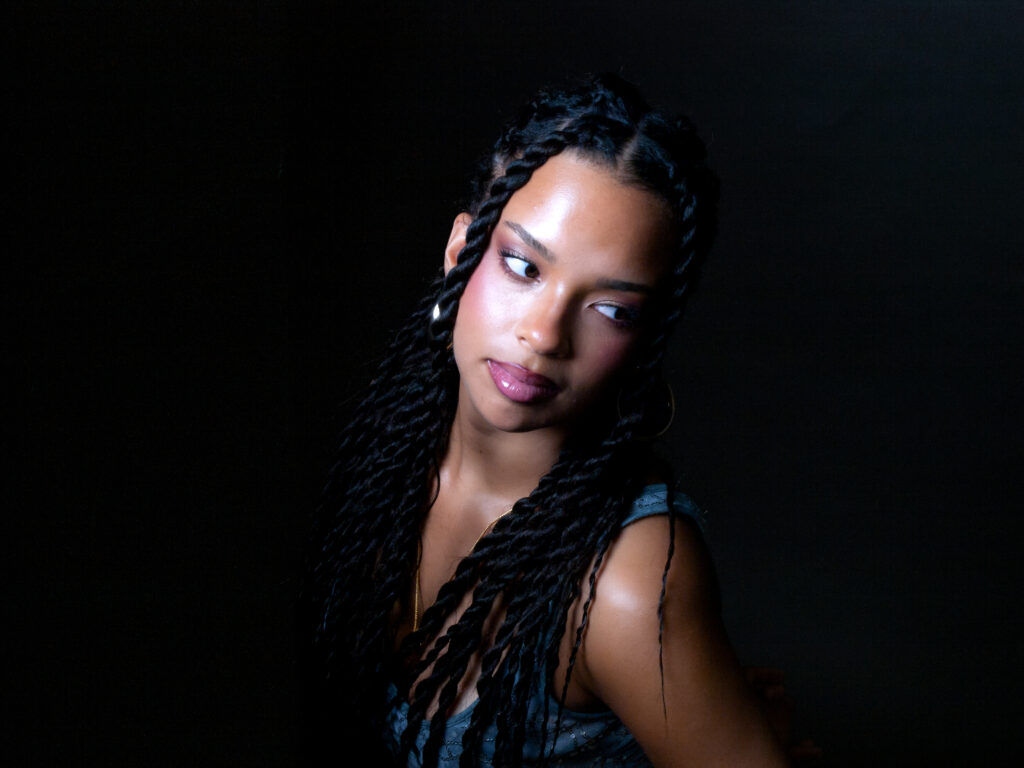
There are lots of reasons why artists change their names. Prince did it in protest. Yasiin Bey altered how he was known to honor his cultural heritage. And for Nashville R&B singer-songwriter Kyleigh, she signaled she was serious about establishing her artistic identity by dropping her high school nickname Ca$hK earlier this year.
I talked with her about how her new EP, “Almost Everything” — her debut project as Kyleigh — reflects that transformation.
Jewly Hight: When I listen back to the music that you made as Ca$hK, I can hear the formation of serious ambition. And I wonder what you hear and how you relate to the stuff you made a few years back.
Kyleigh: I did a lot of self-discovery through making Ca$hK music. This [new] project has a lot more live and acoustic sounding things where the Ca$hK music was a little bit more midi and [programming] stuff like that. So I think you can hear the difference in the growth and the depth, especially of the music and the subjects and the way that I’m singing them.
Jewly: How did you determine it was time to put Ca$hK aside as a moniker and move forward as Kyleigh?
Kyleigh: I guess for, like, a year I was doing this inner turmoil thing where I was like, “Ca$hK, who is she?” And I I felt like there was a stigma attached to the name Ca$hK that sort of gave you an idea, a perception of what I might be, what my music might sound like, what my persona was supposed to be giving. And the keyword is “supposed” to be. I was starting to feel pressured to uphold a certain persona that didn’t necessarily align with my true personality. What was holding me back was I just felt like there was a disconnect between who I truly am as a person and the name that I was going by. [My question was], “What’s gonna make me feel the most free?” I think Kyleigh is the perfect way to do it. I think I can grow with that.
Jewly: I wonder what limitations you felt like you shed when you made that move, and at the same time, what territory you were opening for yourself to be able to explore on this debut project.
Kyleigh: I agreed to just let myself explore and play and figure it out. I guess I shed some of these like limiting beliefs and inhibitions that came with trying to be something. This entire experience has been super eye opening and assuring. I feel like I’m getting downloads every day of like who Kyleigh is.
Jewly: Sometimes it helps to look at other artists, and how they’ve insisted on evolving, as part of that process of giving yourself permission. Did you have any reference points in mind?
Kyleigh: One that does come to mind is Muni Long. She used to go by Priscilla Renea.
Jewly: Yeah, I wrote about her back then.
Kyleigh: She was an inspiration; Muni Long and Priscilla Renea are two totally different vibes, both awesome and successful in their own way. And if you’re a true diehard Muni Long fan, you’ll know that she was Priscilla Renea before.
Jewly: You are part of this new-generation R&B scene here. You’re helping it grow because you’ve made the decision to put down roots here and go about the business of career building. How are you making that part of your story, especially as you start to present your music to people outside of Nashville?
Kyleigh: I try to just talk about Nashville and the community here as much as possible. Anytime anyone’s ever asking me, “Why did you choose Nashville?” or “Why have you chosen to stay?” I just always go back to the support system and the amazing collaborators and people that are here that I just couldn’t trade for the world. How I keep that a part of my story is just by constantly reminding everyone that this has been a team effort.
Being a part of that group of people that are in this movement, I feel so honored and proud and I just wanna keep on doing it for Nashville and for me and just for all the people in this R&B scene that are trying to make Nashville more than just the Music City [that people know].
Jewly: That includes Summer Joy, your roommate and fellow artist, and musicians like TeAndre Holmes, who I met when I followed 2’LiveBre out to speak and perform at a school; TeAndre was playing keys with him that day. What difference do you feel like it made that you could take up sensitive subject matter with collaborators your deeply trust?
Kyleigh: I think it probably made a world of difference. The subject matter was all really personal things and stuff that I was kind of working and maturing and healing through. Being surrounded by people who are my best friends, who have known me for years and have seen some of this stuff unfold and helped me through it, I think that makes all the difference to be able to just be vulnerable. [I can’t imagine] going into a room full of strangers and being like, “Hey, you guys don’t know me, but let’s write a song about my dad who was never around.”
Jewly: People think of Nashville as a songwriting and recording hub. It has this reputation for professionalism, the studio pros that can nail it and make it sound effortless. But people don’t always associate R&B of the past and present with that professionalism. So tell me about how, through the relationship you’ve built with your producer Robbie Ricucci, you’ve worked together to develop your sound and polish it.
Kyleigh: That’s an interesting question, because we’re kind of in this stage of an ever-evolving sound with the EP. The tracks are so multi-dimensional. Each one is entering its own kind of world. Every few sessions, I’m like, “Is this RB enough?” And Robbie’s like, “It’s you.” So we coined the term “Kyleigh music.”
We came up with, like, five different versions of each song. I would come in and we’d just throw something on the wall and have a million different tracks. And it got peeled back and back and back, until we came up with what each one of these songs turned out to be.
Jewly: The end result is not at all cluttered. Beat-making subtly accents the hand-played instrumentation at the center of the music. But you’ve built in some moments that are grand in scale, including the opening song “Confessions.”
It sounds like you’re building up to these vocal arpeggios where you’re stretching your range and opening yourself up and embracing both possibility and risk of expressing emotional truths. How do you feel like that song sets the tone for the project?
Kyleigh: The whole like intro part of it is basically me saying, “I have a lot of things that I haven’t talked about. What’s gonna happen to me if I do open myself up like that?” With the arpeggio section, I was hoping to capture this feeling of screaming into a void or looking out over this mountain range or something.
Jewly: In the making of your song “LMLM,” how did you take something that is so emotionally complex and craft it into a hook that actually stays with you? You don’t necessarily think of a pop song as being able to carry that kind of story.
Kyleigh: At first it was a little bit more emotional and slowed down to this boom bap kind of rhythm. And I found myself kind of struggling, [because] I didn’t want it to be heavy. I wanted it to feel boppy and catchy and happy, because I liked that juxtaposition. Especially because I feel like the song itself is a little bit cheekier. It’s not woe is me. It’s kind of like, “I knew this was gonna happen. Isn’t this what always happens?” So I wanted it to have a sassier, more laidback feel that makes you feel like, “Maybe she’s more self-realized, so she can bop around to this, because she knows what’s going on.”
Jewly: Your original intention was to explore inconsistencies in your relationship with your dad in that song, but it could apply to a lot of different kinds of relationships where people are abusing your trust.
Kyleigh: Right. People who have heard the song are coming to me being like, “Oh, it’s about your dad? I thought it was just about a love relationship.”
That’s great. I want you guys to be able to apply whatever this is about for you. That’s what the whole purpose of this music is, is to make you feel better, make you feel seen, heard, understood.
Jewly: In the song “Run,” you get into your hip hop bag with that with that vocal flow. Where do you feel like that fits in your repertoire as a as a vocalist?
Kyleigh: It’s just been something I’m exploring. I like the more like melodic rap, and this is a deep cut, but I actually have a rap song out on my SoundCloud from Ca$hK days.
It’s definitely gonna be part of the future of Kyleigh. I don’t wanna keep myself back from doing the things that I love and enjoy and think sound cool. If I wanna rap, I’m rapping. And I’m actually pretty good at rapping.
Jewly: We need more women rapping in Nashville.
Kyleigh: I’m not gonna go as far as to say I’m gonna start rapping all the time or it’s gonna become my main deal. But I can whip it out every now and again, do a quick little one two, one two.
Jewly: There are lots of moments on the EP where you make us want to lean in so that we don’t miss anything, because the communication feels intimate. But it ends with a song, “Everything,” that has cinematic, orchestral elements to it. What felt right about ending on that grand scale?
Kyleigh: “Everything Is everything” I think, as a concept, is already a very grand idea. I wanted to convey something really sweet and hopeful. When I think of what that sounds like to me, that sounds like strings and harps and horns. The idea that I was trying to express is that the clouds do open up and the sun does come back around and it’s all good, girl.
Copyright © 2025 WPLN News