“Singing, honey, that is like breathing to me.”
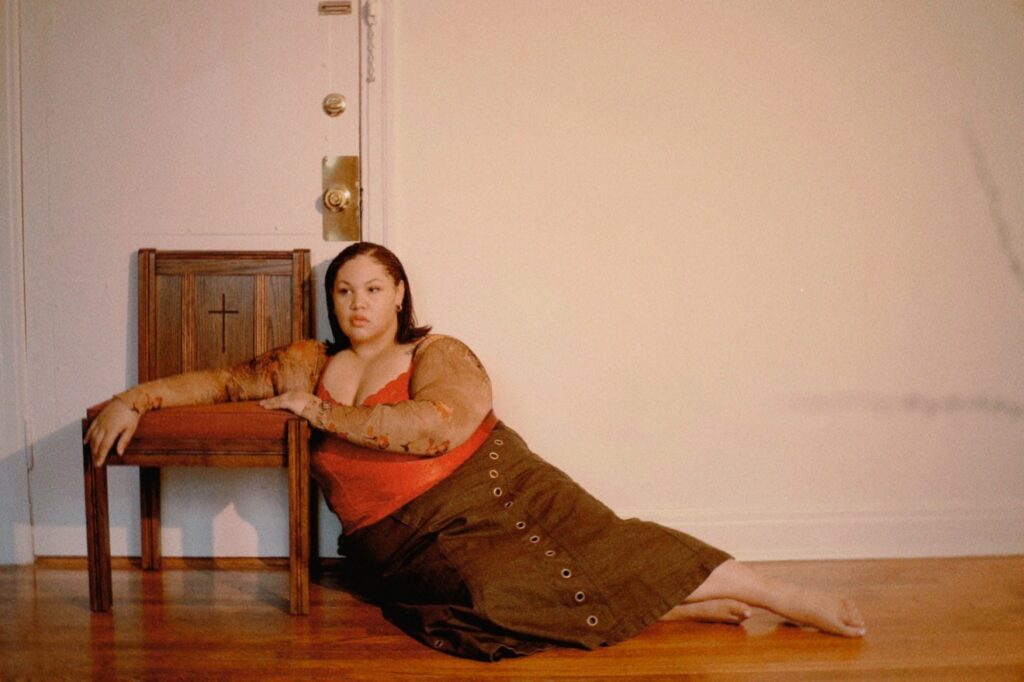
All that I’ve asked Summer Joy to do is say her name into the microphone, so that I can make sure that I’ve properly set the recording levels. But she’s primed to plumb the depths of her approach to music-making.
Joy spent much of her youth in Columbia, Tenn., where she transitioned from playing French horn in the school band to singing with a local jazz combo before moving just an hour north to attend Belmont University. The school’s appeal was that the singer Yebba — whose viral live performance captivated Joy with its elliptical and eruptive expression — had briefly studied there.
Joy emerged a singer-songwriter with strong ties to Nashville’s young-and-rising R&B scene. In March, she released her debut project, the “Lessons in Love” EP. Its five tracks drift by in just 13 minutes, all rustling acoustic textures and jazz undertones, but it’s hardly a slight statement. With her posture of openness and the reedy, winning warmth of her vocals, Joy inquires into the limitless capacity of love.
She sat down in the Nashville Public Radio studios for one of her first in-depth interviews to date.
Jewly Hight: Recently I was talking with someone about how few new singers they hear working in the tradition of the great pop, jazz, soul and R&B virtuosos who made the most of their vocal instruments. I told them that they ought to check out Summer Joy.
Summer Joy: Thank you for seeing me in that. Even when I was first learning to sing and finding my voice, all the people I would listen to, Aretha, Whitney, Adele, [were] all these great belt[ing] queens.
People usually think that I grew up in, like, a Southern Baptist church with a big choir, and I grew in a small, traditional Lutheran church singing hymns. It’s really the music that I listen to on my own is where I learned how to sing.
I started my musical journey singing and then playing music, classical music, and then singing again. I always thought I was just gonna be a singer, and that I couldn’t write these great songs. And then I started to realize writing is just having a conversation. It’s just singing what you want to say.
Jewly: At one point in time, you were playing French horn, and that’s an instrument that people often compare to the human voice because of its range and its timbre. What aspects of studying the horn do you feel like carried over to how you treat your voice as a serious instrument?
Summer: My band directors, they’re like, “Summer, if you want to play French horn, it requires a really good ear.” It’s not just pressing buttons. You have to almost hear it and imagine it. Intonation is a huge thing.
Especially with singers, because [our instrument is in] our bodies, we have to control it. There’s so many things you can do with your mouth and your placement and using your soft palate or your hard palate, singing from the back of your throat or the front of your teeth. There’s so many different techniques that I’ve studied and I think I have very good control over my voice. Looking back, it has to do a lot with my background in French horn, that early training of my ear.
Jewly: In Nashville, a lot can ride on how you’re categorizing yourself, or more to the point, how other people categorize what you’re doing. A lot of industry opportunities are based on who’s perceived as belonging in specific genre scenes.
I’ve seen you hold your own even when you’re the only artist of color with jazz and R&B chops in otherwise country- or roots-leaning writers rounds and showcases. What insight have you gained from moving through those spaces?
Summer: As I started venturing out, singing out in public, there was not a lot of writers rounds that would even let me play. Now I realize that being different is my superpower. It makes me stand out.
But mind you, in Nashville the underground scene has always been here; the talent and the diversity, it’s always being here. The light has just not been shown on it.
I think I’ve just been blessed with one of those voices that can unify across all genres. Because at the end of the day, how I would define my sound [is] you will always hear my heart and you will always hear my soul. That’s just in my delivery and how I emote. Singing is more than just singing to me. Writing is more than writing to me. There’s greater purpose in it.
I want to be one of those people who is pioneering because I feel like there’s a movement right now as the underground is bubbling up. We all realize that Music City is not just country, it’s Music City.
Jewly: There’s a strong tradition in Nashville of working with hand-played instruments. Your work also makes me think of a tradition that came together in New York in the late ‘90s and early 2000s, when neo-soul visionaries like D’Angelo and Eryka Badu shaped the sound and feel of their music through intimate exploration with the musicians they trusted, known as the Soulquarians. How does that compare to the approach to collaboration you’ve developed here?
Summer: First and foremost, I’m a musician. The musicians, especially in this town, it’s a very tight-knit community, and we all look out for each other and support each other. That’s something I forever want to take into my music, and I want to bring that into mainstream as well.
I’m the type to walk off stage and let the band play, because they deserve that moment too. It’s about collaboration for me. And I think collaborating and even just hanging out outside of music, building that bond, that’s when the best music comes about, when you can learn to trust each other and communicate without talking. With me and my band and the people that I like to play with, that’s when I can fully let go, when there’s that camaraderie.
I love live instrumentation within my music, because it’s just that raw human quality. There’s things that in the digital age that you can’t replicate, like a real person playing. Just as I emote into when I’m singing, my pianist is emoting when he plays. He’s just pouring out his heart. I feel like that’s individual to each player, and I encourage that within my music. If you’re playing for me, it’s yours. You’re also a part of it.
Jewly: You only started releasing music in 2024, and I found it pretty striking that those early tracks sound like the work of an artist who’s patiently exploring. What were you aiming for with that first material?
Summer: Being at Belmont, being surrounded by all these people who have been writing for so long, I felt very inadequate. But around that time, I was like, “I’m gonna give it a shot.”
“Bum Boy” was the first song I ever wrote in pursuit of my artistry. I wrote that in my college dorm room. That song is about my dad, and that is a conversation I would have with him if I had the chance.
Really, that first era of my music that I released, that was all just me finding what color ink I got in my pen.
I still write in jam sessions today, because I just love the flow of it. I think some of my work is better when I just freestyle.
Jewly: You really showcase that approach to creating on this EP. How did you find the right players in Nashville to welcome into your inner circle?
Summer: Towards the end of Belmont, I was just starting to go out into the city and gig here and there and just network. I found some musicians that are like family.
They were at the very beginning of when I started just creating music. We would have random jam sessions, like, once, twice a week until 3 a.m. That’s how I built up a lot of my confidence, just being able to write and creating music in its most raw form. Just you and some musicians, and y’all just catch a vibe, catch a feeling. Those are the people I trust the most with my music, because they were there when I was learning. That’s how I like to operate. It just feels the most free-flowing.
Jewly: Your song “Keep Me Where It’s Warm” sounds like it could have emerged in exactly that type of environment.
Summer: That that whole song is freestyle. It was just me, my pianist, drummer and a bassist and they just started playing. [My] original voice memo is a little bit different from the recording that we ended up with, but the melody and what I sang is the same.
In these jam session environments, there’s that magic and that synergy with your musicians who are bringing their own influences and their own hearts to the table and we just created something that is just undeniable to me.
Jewly: Your song “Psilocybin” isn’t a linear piece of music. Halfway through, you shift in feel and tempo. What kind of open-ended journey did you take to creating that song?
Summer: I love it when the song structure mirrors the emotions being conveyed. In “Psilocybin,” he first half of the song is calm, cool, and collected. But the lyrics are more angsty, more of that annoyed feeling of, “Why does it have to be like this?” But the second half of the song, it’s that angst amped up, but with that piece of letting go.
Jewly: “Love’s Letter” is another song that does not feel bound by traditional song structure. In the middle of that track, you drift into these wordless vocal lines, then whistling. What felt right to you about letting the song kind of drift into wordless expression, as opposed to just like tying it up neatly?
Summer: Sometimes what I fill is not perfectly structured. When I was writing that song, I was in a flow state, writing my letter to love. I didn’t want it to end. The end of the song — or at least the last words — is “Now that I have love to myself, I can give it away.” I think that’s something that has no end. There is no end to love. That’s how I wanted the song to feel, like there’s no hard cut off. It’s just flow until it dissolves.
Copyright © 2026 WPLN News